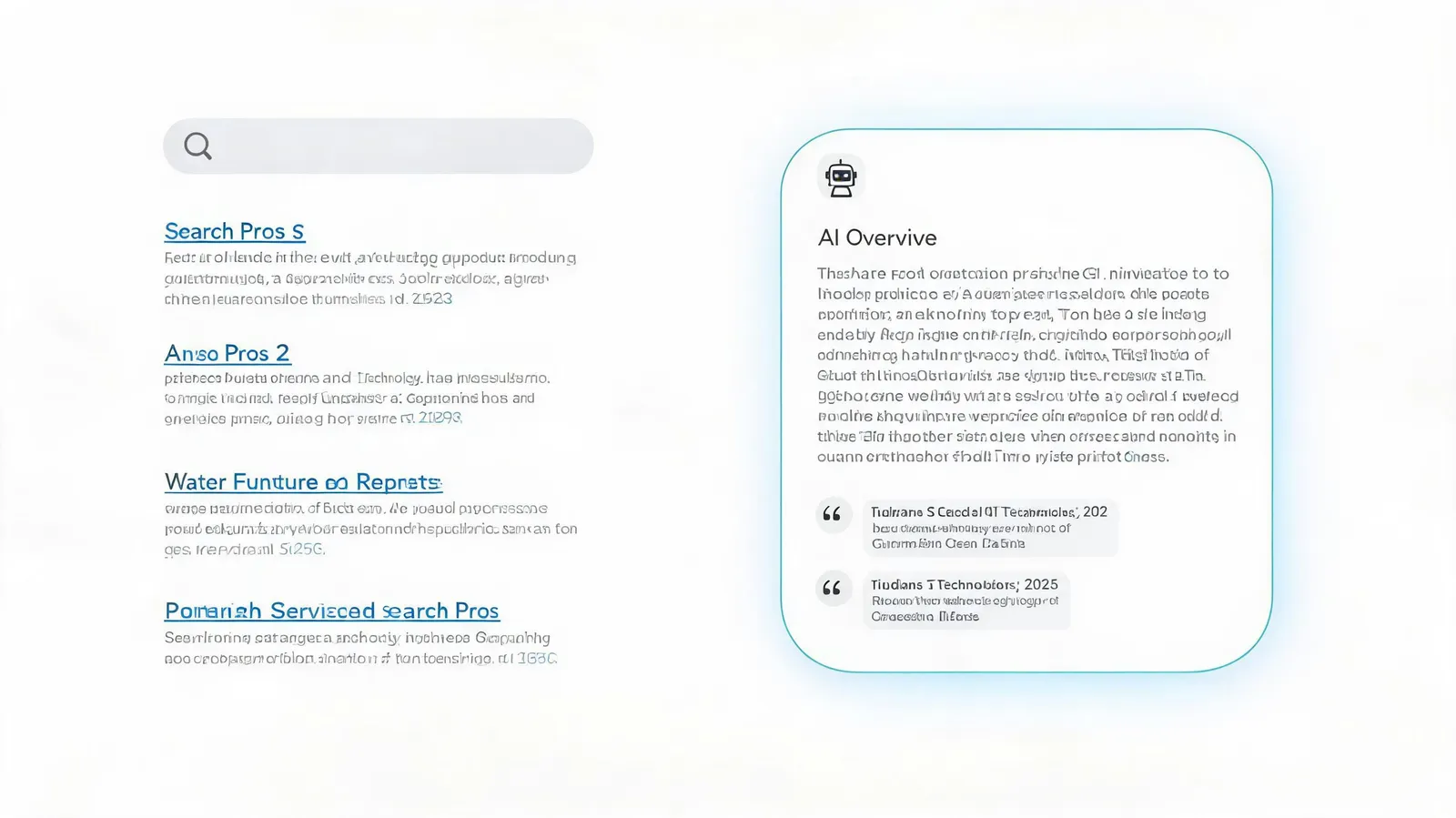
Search results increasingly resolve questions on the page itself, leaving fewer clicks for publishers and upending an SEO model built on traffic. AI Overviews, chat-style assistants such as ChatGPT, and zero-click results are changing how people locate and absorb information. Staying visible now requires moving past ranking positions toward optimization for AI answers, structured data, entity authority, and revised attribution approaches.
Winning Citations in AI Overviews and Conversational Queries
AI Overviews — the feature once called Search Generative Experience (SGE) — are AI-written summaries placed above Google's standard results. They combine material from several sources into a direct response, which frequently means the user never clicks a link. Ahrefs research published in 2025 found that AI Overviews show up in roughly 45% of Google searches, and in those cases the top organic result's click-through rate can fall by up to 30%. Ranking first is therefore no longer sufficient; the goal is to have your content quoted inside the AI-generated answer itself.
Start by understanding how these summaries choose and merge sources. Google's AI systems favor content that is authoritative, clearly organized, and gives a direct response to the query. Formats that tend to be picked up include question-and-answer sections, bulleted lists, definitions, and step-by-step guidance. A query such as "what is entity SEO," for instance, may draw a short definition from a well-optimized blog post and credit that post as a source. Clear headings, tight paragraphs, and straightforward answers to common questions improve the odds of being cited.
Equally important is writing for conversational search. Such queries run longer, sound more natural, and are frequently framed as questions. Voice search, now responsible for more than 30% of mobile searches, reinforces this pattern. Use everyday language, pursue long-tail keywords, and address the who, what, when, where, why, and how of your subject. A 2024 case study described a B2B SaaS company that lifted its AI citations by 40% after reorganizing blog content into Q&A form and adding FAQ schema — evidence that tailoring content to conversational search can raise visibility in AI answers directly.
Structured Data and Entity Signals That AI Retrieval Relies On

Schema markup, or structured data, is a standardized way of describing a page and classifying what it contains. It lets search engines interpret your content and can qualify a page for rich results. For AI answers, structured data supplies models with explicit facts, which raises the chance your content is retrieved and cited. FAQ, HowTo, Article, and Product are among the common schema types. Research published by Search Engine Journal in 2025 found that pages carrying schema markup are 25% more likely to be cited in AI Overviews. One e-commerce site, for example, recorded a 15% gain in AI citations for product-related queries after adding Product schema to its pages.
Adding schema markup is not complicated. You can use Google's Structured Data Markup Helper or insert JSON-LD directly into your HTML. FAQPage schema suits FAQs, while HowTo schema fits instructional guides. The markup must match what the page actually says, since misleading schema can trigger penalties. Once schema is in place, run pages through Google's Rich Results Test to verify eligibility.
Entity authority is the second pillar of retrieval optimization. An entity is a distinct, clearly defined person, place, thing, or concept. Google relies on entities to map relationships among things and to populate its Knowledge Graph. Building entity authority involves keeping NAP (Name, Address, Phone number) details consistent across the web, creating topical clusters of content around your core entity, and earning mentions and backlinks from authoritative sources. A 2024 case study found that a healthcare provider raised its AI citations by 35% after improving its entity presence in the Google Knowledge Graph and building topical clusters around medical conditions. Google's Knowledge Graph Search API and third-party entity extraction tools can help you monitor and strengthen entity authority.
New Metrics and Attribution as Clicks Fade
With clicks declining, conventional SEO measures such as sessions and click-through rate tell you less. An AI-first landscape calls for different KPIs to gauge visibility and success: impressions, share of voice, AI citation frequency, and brand lift. Impressions capture how often your content surfaces in results regardless of clicks. Share of voice compares your visibility with competitors across a keyword set. AI citation frequency records how often your content is quoted in AI answers. Brand lift tracks gains in awareness and consideration tied to your search presence. A Semrush report from 2025 put zero-click searches at 65% of all Google searches, which makes these metrics necessary for understanding actual performance.
Attribution models also need updating to account for dark traffic and assisted conversions. Dark traffic covers visits that arrive without a referrer, such as those from messaging apps or secure search. Assisted conversions happen after several touchpoints, AI answers among them. Multi-touch attribution models in tools such as Google Analytics 4 or Adobe Analytics can capture these. A 2024 case study described a retail brand that used multi-touch attribution to find that 20% of its conversions were assisted by AI answers, even though those conversions had previously been credited to direct traffic. Monitoring brand mentions in AI answers with tools like Brandwatch or Mention adds another layer. Combining these methods yields a dashboard that reflects how search visibility actually works now.
Conclusion
Adapting to AI answers turns a perceived threat into an opening. Optimizing for AI Overviews and conversational search, deploying structured data and entity strategies, and adopting new measurement and attribution models can help sustain visibility and results even when search produces no click. Generative AI in search will keep changing, so ongoing learning and testing matter. Begin with an audit of your content for AI-friendliness, add schema markup, build entity authority, and track the new KPIs. The future of SEO lies in being the answer, not merely a link.