Coordinated Agent Teams Drive Sales Workflows End to End
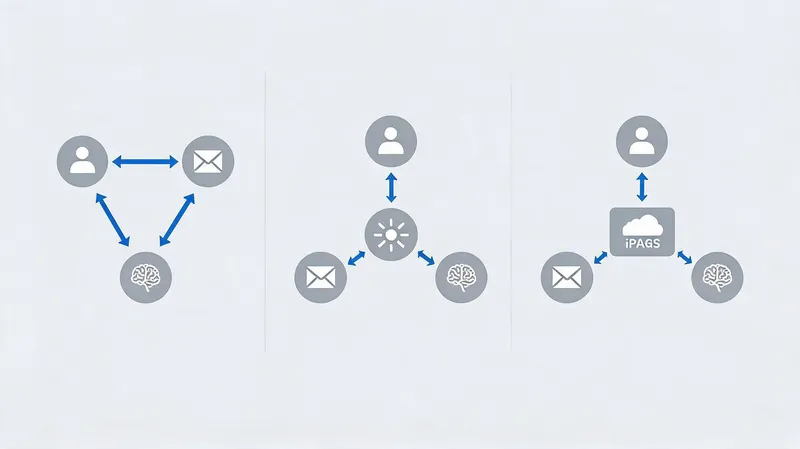
Rule-based sales automation has a well-known weakness: it only copes with predictable if-then scenarios. Once buyer behavior changes or a deal needs several steps of reasoning, such systems break down. Agentic AI takes a different route—it puts several specialized agents to work together across the sales cycle. Each one covers a narrow area: lead scoring, outreach drafting, objection handling, or contract wording. These agents are not isolated; an orchestration layer coordinates what they do, manages the handoffs between stages, and keeps context flowing forward.
Lead response speed is where the difference shows most clearly. In many enterprises, a lead can sit for hours or even days before a seller reaches out. A coordinated agent system can qualify, rank, and engage a lead in seconds. Early adopters report a 25% increase in qualified pipeline, attributed to engaging leads while intent is still high. Frameworks such as LangChain and AutoGen make orchestration layers easier to build, but domain-specific agent design is where the value lies. A lead-scoring agent trained on a company's own historical win data will outperform a generic model every time.

Approval Checkpoints Protect High-Value Deal Decisions
Giving agents autonomy is not the same as handing over responsibility. The sales deployments that work best keep people firmly involved in high-stakes calls. Threshold-based approval is the most common approach: when a deal passes a set value—$50,000 or $100,000, for instance—a human review is triggered automatically before the AI moves on to contract generation or discount approval. This straightforward control cuts costly mistakes and helps sellers trust the system.
Confidence scores serve as a second safeguard. If an agent's confidence in a recommendation falls below a defined threshold, the case escalates to a human seller instead of the agent guessing. This matters especially in objection handling, where a wrong response can harm a customer relationship. Early adopters' case studies indicate that a co-pilot arrangement—AI proposes next steps, humans approve—lifts win rates by 15-20% and also raises seller satisfaction. Sellers describe themselves as augmented rather than replaced: they spend less time on administrative work and more on strategic conversations that close deals.
CRM, ERP, and Revenue Operations Connections Form the Backbone
Agentic AI is limited by the data it can reach and the systems it can act in. Deep integration with CRM, ERP, and revenue operations platforms is therefore essential, not optional. Bi-directional sync means each AI action—an email sent, a call logged, a contract drafted—shows up in the CRM right away. Manual data entry, a long-standing drag on sales productivity, goes away. Data accuracy also improves, since the AI does not skip a field or misspell a company name.
A larger benefit is the unified revenue operations view. When agents can pull from CRM, ERP, and billing systems at the same time, they can produce insights that would be impractical to assemble by hand. A sales leader can see in real time how a discount request in the CRM affects margin calculations in the ERP and cash flow projections in finance. Companies that reach this 360-degree view report notably faster quote-to-cash cycles. The AI does more than automate tasks—it links departments that historically worked in silos.
Governing Autonomous Sales Actions: Risk and Auditability
Governance becomes essential once AI agents take actions that touch revenue, compliance, and customer relationships. Every AI action needs to be auditable—logging not only what the agent did but why. Regulatory frameworks such as GDPR and SOX require sales records to be accurate and traceable. An AI that records each decision with its rationale—the data points considered, the confidence score assigned, the alternatives rejected—makes compliance reviews straightforward rather than painful.
Logging alone is not enough for risk mitigation. Bias detection algorithms can flag cases where an agent's recommendations consistently disadvantage particular customer segments. Fallback protocols ensure that if an agent fails or produces low-confidence output, the workflow degrades gracefully to a human operator. Continuous monitoring dashboards track agent performance over time and alert operators to drift or degradation. One financial services firm that put these controls in place reported a 40% reduction in compliance violations within six months. The lesson is clear: autonomy without governance is a liability, while autonomy with governance is a competitive advantage.
Outlook: Autonomous Revenue Operations
Agentic AI is not a replacement for salespeople; it is an augmentation of them. Coordinated agent teams take over the repetitive, data-heavy work that fills about 70% of a seller's day. Approval checkpoints keep human judgment and accountability in high-value decisions. Deep CRM, ERP, and RevOps integration creates a connected backbone that turns isolated data into usable intelligence. And solid risk management builds the trust needed for broad adoption.
The road ahead looks even more promising. Self-improving agents that learn from every deal—won or lost—will keep refining their strategies. Fully autonomous revenue operations, in which agents negotiate routine contracts, adjust pricing in real time, and predict churn before it happens, are no longer science fiction; they are the logical next step. Organizations that take up this shift, with the right controls and integrations, will rewrite the revenue playbook for the next decade.