Economic Analysis of Exclusive Territories and Resale Price Maintenance
Vertical restraints are contractual terms between firms at different stages of the supply chain—usually manufacturers and retailers—that limit how goods may be traded. Among the most closely examined are exclusive territories and resale price maintenance (RPM). A clear grasp of their economic consequences is a prerequisite for sensible competition policy.
Exclusive Territories: Weighing Investment Incentives Against Intrabrand Rivalry
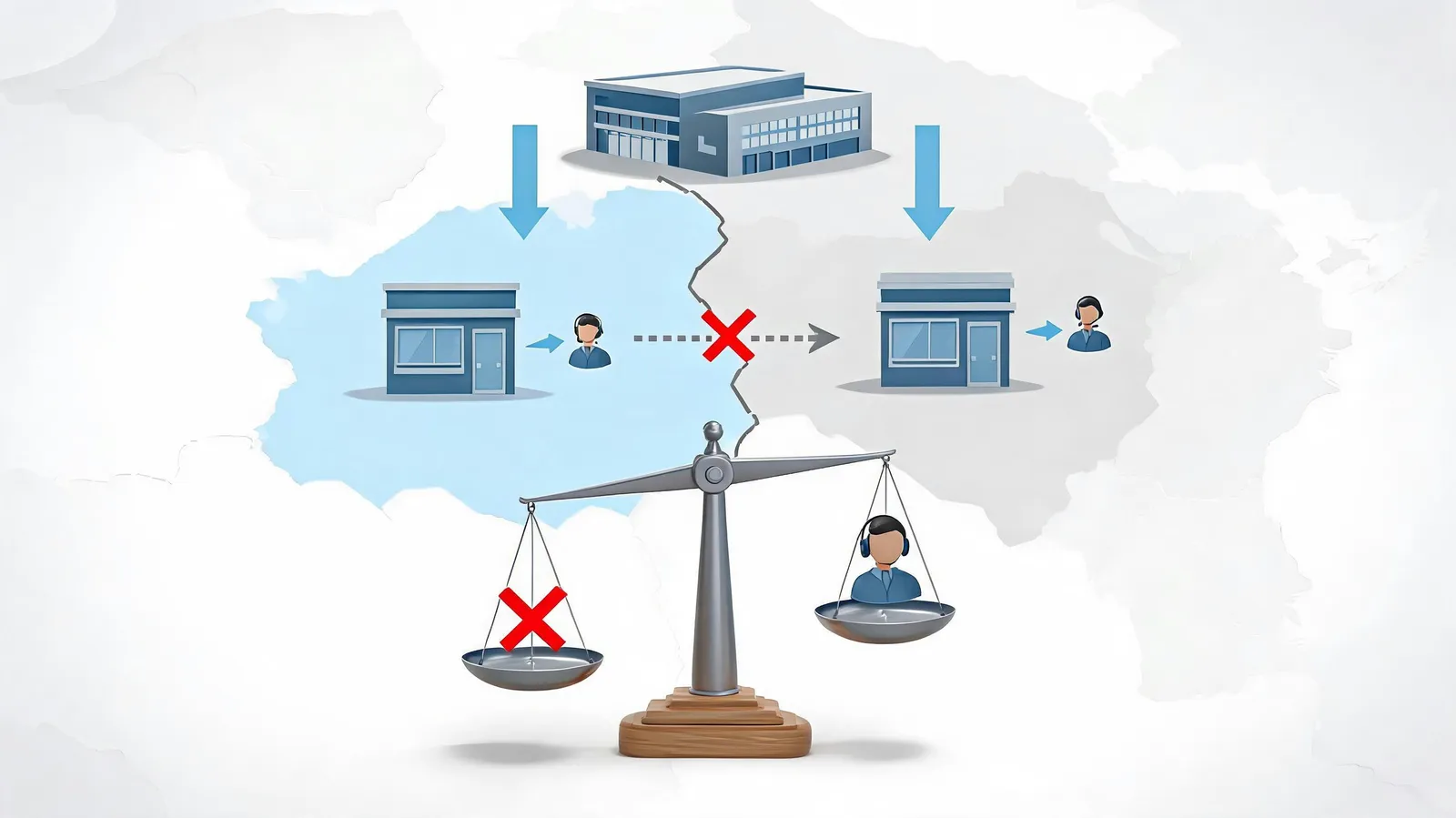
Under an exclusive territory, a single retailer receives the exclusive right to sell a manufacturer’s product in a specified geographic zone. Such a restraint curtails intrabrand competition—rivalry among retailers carrying the same brand—but may spur retailers to invest in promotional services, showrooms, and customer assistance. The familiar free-rider problem emerges when one retailer provides pre-sale services while another free-rides by undercutting the price without offering those services. Exclusive territories can address this by guaranteeing that the investing retailer reaps the returns on its efforts.
Evidence from the automotive and soft drink sectors is mixed. Sometimes exclusive territories raised prices but also improved service quality and product availability; in other instances, they enabled market segmentation and narrowed consumer choice. The central question is whether the restraint is needed to secure efficiencies that less restrictive alternatives cannot deliver.
Resale Price Maintenance: Collusion Facilitator or Double Marginalization Fix?
RPM arises when a manufacturer specifies a minimum or maximum resale price for retailers. For many years, RPM was per se unlawful in the United States. That changed with the Supreme Court’s 2007 ruling in Leegin Creative Leather Products v. PSKS, which adopted a rule-of-reason approach and acknowledged that RPM may have procompetitive justifications.
On the procompetitive side, RPM can address the double marginalization problem—where successive markups by manufacturer and retailer distort price twice—and can encourage retailers to supply demand-enhancing services. It may also ease entry for new brands that need to assure retailers of adequate margins. On the anticompetitive side, RPM can help coordinate pricing among manufacturers or retailers, dampen price competition, and foreclose discounters that innovate.
Approaches differ across jurisdictions. The European Union remains more skeptical, classifying RPM as a hardcore restriction under Article 101 TFEU, although efficiencies may still be asserted. In the US, the rule of reason places the burden on plaintiffs to demonstrate actual anticompetitive effects. This transatlantic divergence complicates compliance for global companies and highlights the need for economic analysis that is sensitive to market context.
Antitrust Review of Vertical Mergers

Vertical mergers bring together firms at different levels of the supply chain. Unlike horizontal mergers, which directly diminish rivalry between competitors, vertical mergers can create efficiencies but also raise foreclosure concerns. Competition authorities in the US and EU have stepped up scrutiny in recent years.
Foreclosure Theories: Input, Customer, and Raising Rivals’ Costs
Input foreclosure occurs when a merged firm limits rivals’ access to a key input. Customer foreclosure happens when the merged firm cuts off a rival supplier’s access to customers. Raising rivals’ costs is a related theory in which the merger increases rivals’ costs, thereby weakening their competitive constraint.
The DOJ’s loss in AT&T/Time Warner (2018) illustrated the difficulty of proving foreclosure effects in court. The government argued that the merged entity would have the incentive and ability to raise rivals’ costs by withholding HBO content from rival distributors. The court found the evidence insufficient, stressing the dynamic nature of the market and the absence of a reliable model. By contrast, the EU blocked HeidelbergCement/Schwenk (2023) over concerns about foreclosure in the cement market, showing that enforcement outcomes vary by jurisdiction and market structure.
Efficiencies and the Consumer Welfare Standard
Vertical mergers often produce significant efficiencies, most notably the elimination of double marginalization. When an upstream and a downstream firm merge, they can internalize the markup, which can lead to lower prices for consumers. Other efficiencies include synergies in production, distribution, and R&D.
The 2020 Vertical Merger Guidelines in the US explicitly recognized these efficiencies but also maintained a focus on foreclosure. Debate persists over how to balance harm and benefit, with some arguing that the guidelines are too permissive and others that they are too restrictive. The consumer welfare standard remains the touchstone, but its application requires careful, fact-specific analysis.
Digital Platforms and Vertical Restraints in E-Commerce
Digital platforms have reshaped vertical relationships, creating new competitive dynamics and enforcement challenges. E-commerce giants such as Amazon, Apple, and Google operate as both marketplace and competitor, raising novel issues for competition policy.
Platform Most-Favored-Nation Clauses and Price Competition
Platform MFNs—also known as price parity clauses—require sellers to offer their lowest price on the platform. While they can reduce search costs and ensure competitive prices, they can also soften competition among platforms and facilitate collusion. Amazon’s MFN policies have been investigated in the EU and US, with concerns that they harm smaller sellers and consumers. The EU’s e-commerce sector inquiry found that MFNs can restrict competition and limit the growth of alternative platforms.
Vertical Restraints in Online Marketplaces: Exclusive Dealing, Territorial Restrictions, and Algorithmic Pricing
Online marketplaces impose various vertical restraints on sellers, including exclusive dealing, territorial restrictions, and algorithmic pricing tools. Exclusive dealing can foreclose rival platforms, while territorial restrictions can segment markets and limit cross-border competition. Algorithmic pricing can facilitate tacit collusion, as pricing algorithms may learn to coordinate without explicit communication.
Cases against Apple’s App Store and Google’s Android have highlighted the tension between platform rules and competition. Germany’s Facebook case (2021) addressed data-driven market power, showing that privacy and competition law can intersect. The impact on small businesses and consumers is profound, as platform policies can determine market access and pricing.
Competition authorities are grappling with how to apply traditional vertical restraint analysis to digital markets. The two-sided nature of platforms, network effects, and data-driven advantages require new tools and approaches. The EU’s Digital Markets Act and the US’s proposed American Innovation and Choice Online Act are legislative responses to these challenges.
Conclusion
Vertical restraints and competition policy are at a crossroads. Exclusive territories and RPM can enhance efficiency but also harm competition. Vertical mergers can generate substantial benefits but also raise foreclosure concerns. Digital platforms have introduced new forms of vertical restraints that challenge traditional enforcement frameworks.
A rule-of-reason approach that weighs efficiencies against anticompetitive harms remains the most sound basis for competition policy. However, it must be tailored to market context and updated for the digital age. International convergence on best practices, greater reliance on economic analysis, and clear guidelines for digital markets are essential. As markets evolve, so too must the tools we use to protect competition and consumer welfare.