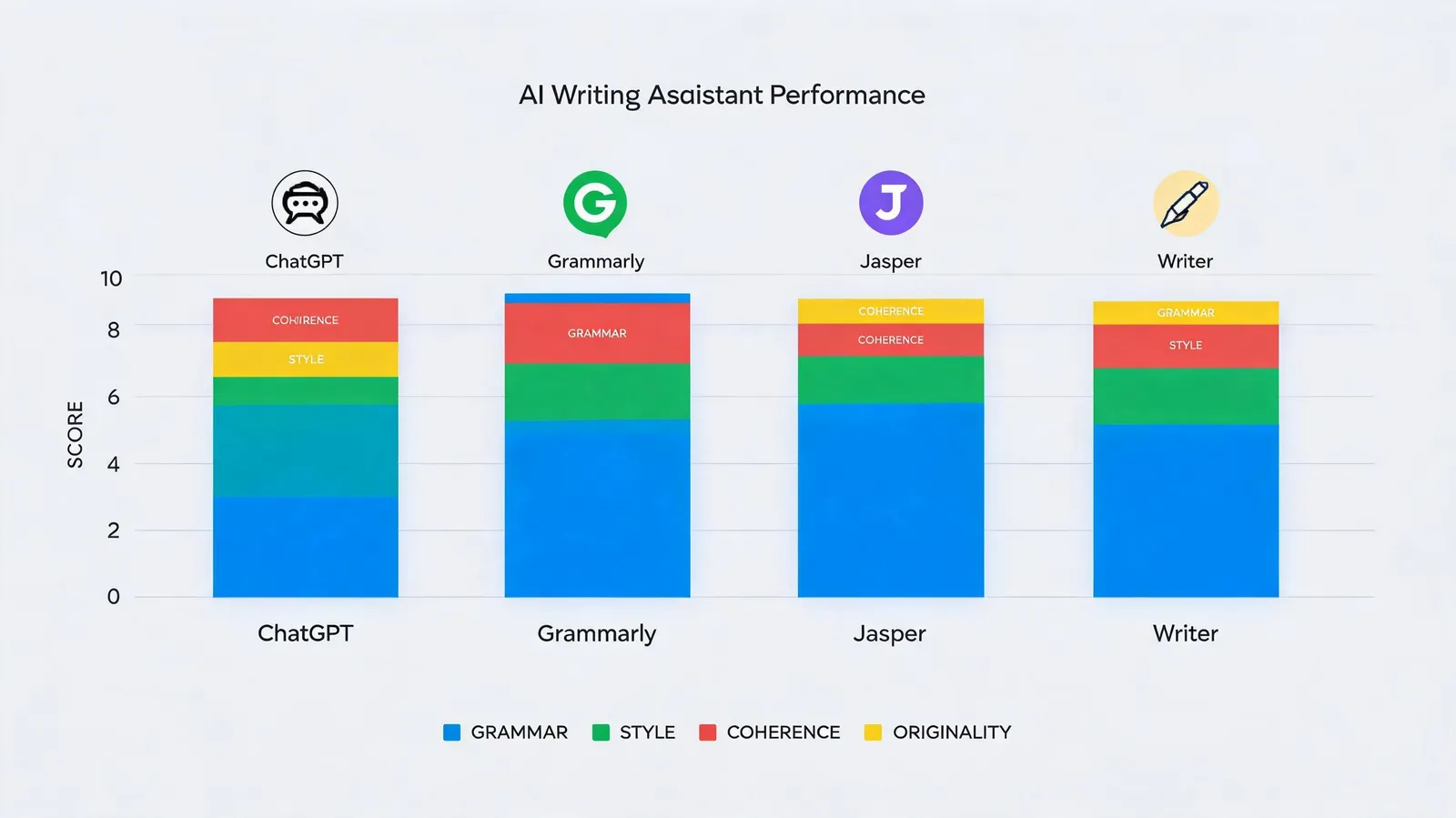
Architectural Foundations for Long-Form Generation
Large language models (LLMs) have moved AI writing from gimmick to practical tool by generating fluent, context-aware text at scale. The transformer underpins this ability: its self-attention mechanism processes every token in a sequence at once and learns relationships among them. That design lets models such as GPT-4 and Claude keep long-range coherence—an essential property for articles, reports, and white papers.
How Transformers and Attention Support Coherence
The transformer, first described in “Attention Is All You Need,” discards recurrence and convolution in favor of stacked self-attention and feed-forward layers. Each attention head can specialize in different parts of the input, so the model captures dependencies no matter how far apart they occur. In long-form writing, this means later paragraphs can draw on earlier ones, helping preserve narrative flow and logical structure.
Context windows remain a constraint. Most models accept a fixed maximum number of tokens (8,192 or 128,000, for example). Once content exceeds that limit, earlier context is cut off, which can cause repetition or breaks in coherence. Approaches to this problem include sliding-window attention, hierarchical summarization, and memory-augmented architectures. Anthropic’s Claude 3, for instance, supports up to 200,000 tokens—enough for book-length work—but still needs carefully designed prompts to stay on track.
Strategies for Narrative Flow and Structure
Architecture alone is not enough; generation strategy matters for long-form quality. Hierarchical generation—outline first, then section-by-section expansion—helps maintain global structure. In outline-based prompting, the user supplies a detailed outline that steers the model through a logical progression. Case studies indicate that AI-generated articles produced with outline-based prompting score higher for coherence and organization than those generated without such structure.
Iterative refinement is another tactic: produce a draft, then ask the model to revise specific sections for clarity, tone, or factual consistency. This mirrors human editing and can substantially raise output quality. Tools such as Sudowrite and Jasper AI build such workflows into their products, letting writers collaborate with AI in a structured way.
Adapting Models and Prompts for Brand Voice
Base LLMs are capable but often sound generic, lacking a particular brand voice. Fine-tuning and prompt engineering help align AI writing with an organization’s tone, style, and terminology, so the output reads as if the brand wrote it.
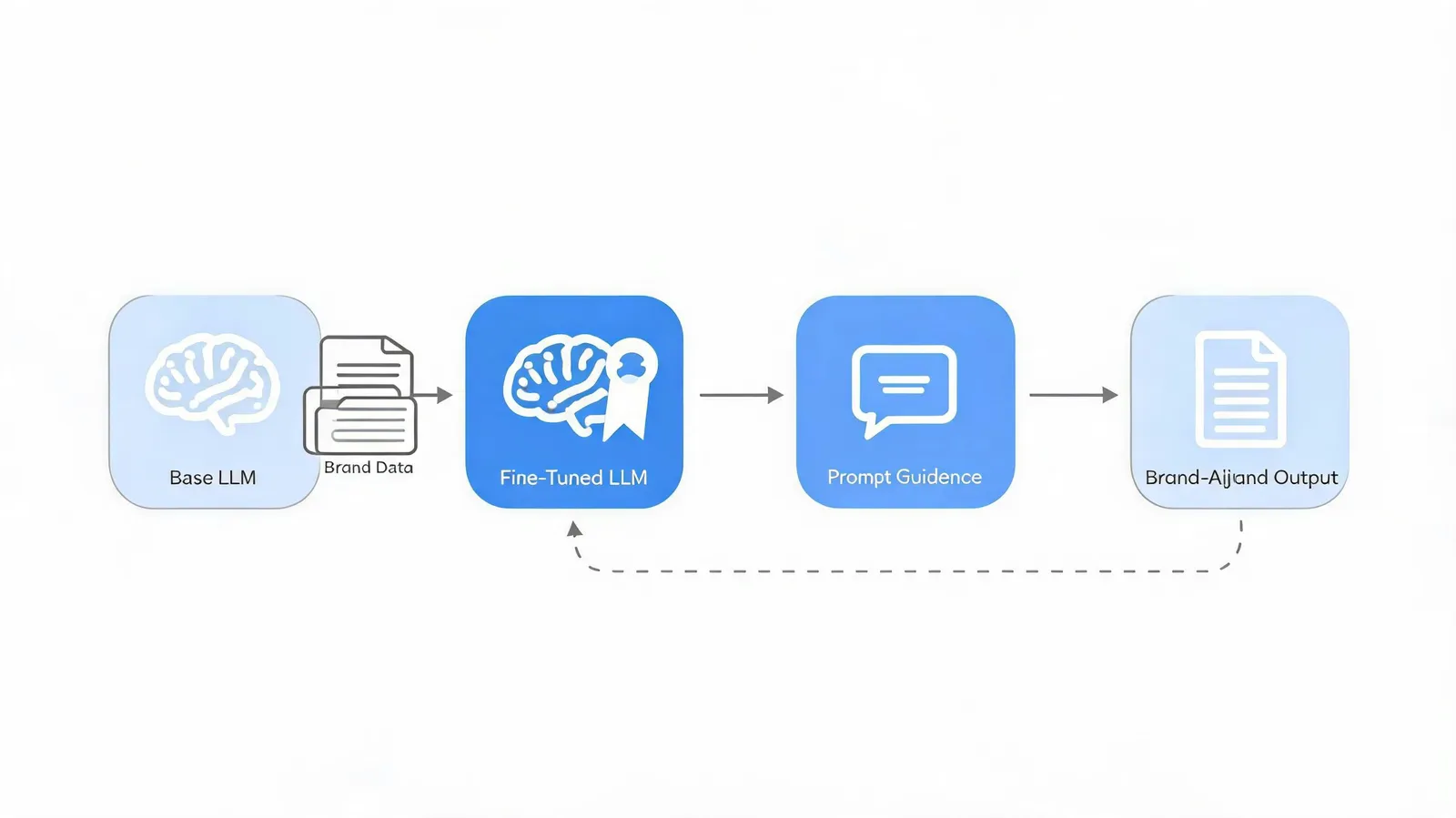
Fine-Tuning: Full Models vs. Parameter-Efficient Approaches
Fine-tuning continues training a pre-trained model on domain- or brand-specific data. Full fine-tuning updates every parameter, which is computationally costly and data-hungry. Parameter-efficient methods such as LoRA (Low-Rank Adaptation) and adapters add small trainable modules, cutting cost and storage dramatically while delivering comparable performance. A company can, for example, fine-tune on its past blog posts, style guides, and customer communications to capture its distinctive voice.
Cost and performance comparisons suggest LoRA can reach 90–95% of full fine-tuning quality using only 1–5% of the trainable parameters, making brand-specific models feasible for smaller organizations. One financial services firm fine-tuned a Llama 2 model on its research reports; analysts rated the resulting AI-generated content as indistinguishable from human-written work in tone and terminology.
Prompt Engineering for Consistent Tone and Style
Prompt engineering complements fine-tuning by guiding output without changing model weights. Few-shot prompting supplies examples of the desired style, while style-transfer prompts ask the model to rewrite text in a particular voice. A prompt such as “Write in the style of a professional but friendly tech blog, using active voice and avoiding jargon” can effectively steer the model.
Prompt management and testing tools, including PromptLayer and Humanloop, let teams version prompts, A/B test variations, and monitor output quality. Recommended practices include clear instructions, worked examples, and iteration driven by evaluation metrics. Used together with fine-tuning, prompt engineering helps keep brand voice consistent across different content types.
Retrieval-Augmented Generation for Factual Grounding
LLMs can hallucinate—producing plausible but incorrect information—and that is one of their most serious limitations. Retrieval-augmented generation (RAG) counters this by bringing external knowledge into the generation process, anchoring output in verifiable facts.
The RAG Pipeline: Retrieve, Augment, Generate
RAG runs in three stages. First, an embedding model encodes the user query as a vector, which is used to search a vector database (Pinecone or Weaviate, for example) of document embeddings; the top-k most relevant documents are retrieved. Second, those documents are concatenated with the original query to form an augmented prompt. Third, the LLM generates a response conditioned on both the query and the retrieved context, often with citations.
This method has been shown to improve factuality in news and research writing. A RAG-powered assistant can, for instance, pull current statistics from a database and include them accurately in an article, lowering the risk of stale or false information. A case study of a fact-checking AI writing assistant reported a 40% reduction in factual errors compared with a baseline LLM without retrieval.
Implementing RAG in Content Workflows
Effective RAG implementation starts with choosing suitable vector databases and embedding models. Open-source options such as FAISS and Sentence Transformers are widely used, while commercial offerings provide scalability and managed services. Chunking—how documents are split into passages—affects retrieval quality: smaller chunks improve precision but can lose context. Hybrid retrieval, which combines dense and sparse (keyword) methods, often produces better results.
In content workflows, RAG can be plugged in at several stages: research, drafting, or fact-checking. A content team might use RAG to suggest relevant sources while writing or to verify claims before publication. Good practice includes keeping the knowledge base current, monitoring retrieval relevance, and having fallback mechanisms when retrieval fails.
Measuring the Quality of AI-Generated Text
Evaluating AI-generated text is essential to confirm it meets standards for coherence, fluency, and factuality. Methods divide into automatic metrics and human evaluation.
Automatic Metrics and Their Limits
Automatic metrics compare generated text with reference texts. BLEU (Bilingual Evaluation Understudy) measures n-gram overlap and is common in machine translation. ROUGE (Recall-Oriented Understudy for Gisting Evaluation) emphasizes n-gram recall and is often used for summarization. BERTScore uses contextual embeddings to compute semantic similarity and tends to correlate better with human judgment than n-gram methods.
These metrics have drawbacks. They can penalize valid paraphrases, fail to capture factual accuracy, and correlate poorly with human ratings of creativity or coherence. A factually correct article that words things differently from the reference may receive a low BLEU score, for example. Automatic metrics should therefore be paired with human evaluation.
Human Evaluation and Benchmark Datasets
Human evaluation asks raters to assess dimensions such as coherence, fluency, relevance, and factuality. Best practices include Likert scales, multiple raters, and checks of inter-annotator agreement. Benchmarks such as HELM (Holistic Evaluation of Language Models) and GEM (Generation, Evaluation, and Metrics) offer standardized datasets and protocols for comparing models.
Designing human evaluation studies requires clear guidelines, rater training, and bias mitigation—raters should be blind to model identity, for instance, to avoid bias. Combining automatic and human evaluation gives a fuller picture of AI writing quality and informs improvements to models and prompts.
Conclusion
The AI writing revolution rests on four connected pillars: LLM architectures that support long-form coherence, fine-tuning and prompt engineering that keep brand voice consistent, retrieval-augmented generation that grounds outputs in facts, and evaluation metrics that measure quality. Together they help organizations produce high-quality, on-brand, factually grounded content at scale.
Looking ahead, developments such as multimodal generation (combining text, images, and audio) and real-time evaluation are likely to further change AI writing. As models grow more capable and evaluation methods more sophisticated, collaboration between human writers and AI can deepen, opening new possibilities for creativity and efficiency. For professionals and technology enthusiasts, understanding these pillars is key to making the most of AI writing.