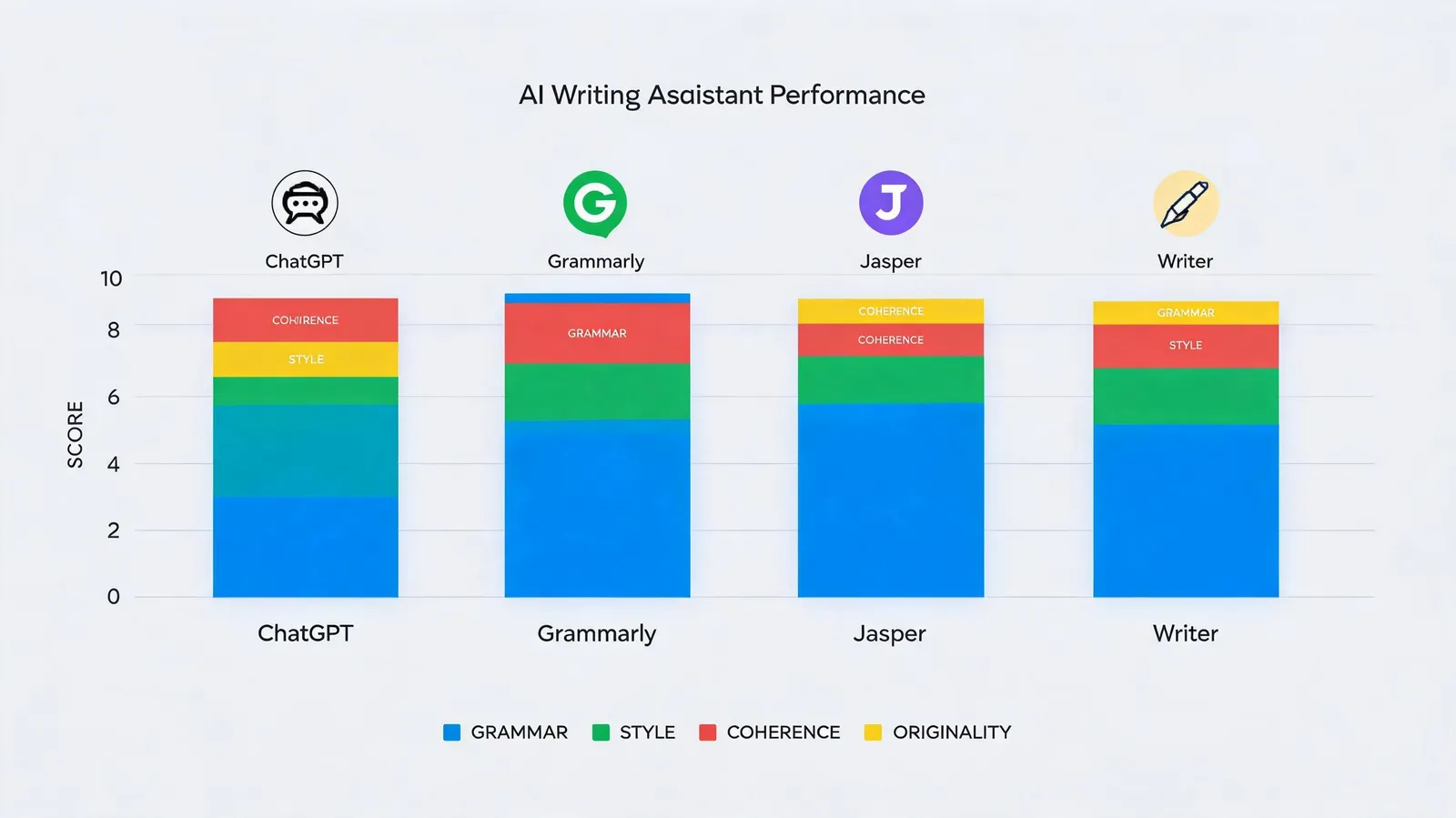
AI Writing for Non-Native Speakers and Language Learning
For millions of people who speak English as a second language, writing with accuracy and confidence has long been a struggle. AI writing assistants are now addressing that gap by offering real-time corrections to grammar, style, and tone that extend well beyond conventional spell-check. Products such as Grammarly and ProWritingAid rely on advanced natural language processing to interpret context, propose stronger word choices, and adjust to varying registers—formal, academic, or casual.
Evidence indicates that these tools can meaningfully boost writing precision and fluency. A 2023 study from the University of California reported that non-native speakers using AI writing assistants cut grammatical errors by 45% and raised overall clarity scores by 30%. The benefit goes beyond error correction: users learn as they go. By reviewing suggestions and explanations, they absorb correct patterns and grow their vocabulary faster than through traditional study methods alone.
AI also drives personalized language learning. Platforms such as Duolingo and Babbel now incorporate AI-generated exercises that respond to each learner's strengths and weaknesses. These systems produce custom sentences, dialogues, and quizzes aimed at particular grammar points or vocabulary gaps. If a learner has trouble with past-tense verbs, for instance, the AI generates additional practice sentences using those forms, raising the difficulty gradually as mastery grows.
This tailored approach speeds up acquisition. Data from Duolingo indicates that learners who use AI-adaptive exercises move through language levels 20% faster than those following a fixed curriculum. The AI also delivers immediate feedback, which matters for building confidence and easing the fear of making mistakes—a significant obstacle for adult learners.
For working professionals, AI writing tools act as a safety net that frees them to concentrate on ideas rather than grammar. A marketing manager in New York who speaks English as a second language can draft a campaign proposal, run it through an AI assistant, and get suggestions that make the text read naturally and professionally. This helps level the playing field, allowing non-native speakers to compete more effectively in the global job market.
Still, AI does not substitute for human judgment. It may overlook cultural nuances or produce awkward phrasing when used without care. The best outcomes occur when users treat AI as a collaborative partner—accepting some suggestions, rejecting others, and always applying their own understanding of context and audience.
AI Writing in Government, Public Policy, and Civic Communication

Government agencies are increasingly adopting AI writing to improve the clarity, accessibility, and efficiency of public communication. From drafting policy documents to translating notices, AI is helping officials reach citizens more effectively and at lower cost.
One major application is automated drafting of policy documents and public notices. Tools like FiscalNote and Quorum use AI to analyze legislative text, summarize bills, and even generate first drafts of policy memos. This saves staff hours and reduces human error. According to a 2024 report by the National Association of State Chief Information Officers, states that adopted AI writing tools for policy drafting reported a 35% reduction in time spent on document preparation and a 25% decrease in associated costs.
But efficiency is only part of the story. AI is also enhancing civic engagement by making government content more accessible. Multilingual translation tools powered by AI can instantly convert public health advisories, voting information, and emergency alerts into dozens of languages. During the 2024 election cycle, several U.S. counties used AI translation to provide voting guides in Spanish, Chinese, Vietnamese, and Tagalog, leading to a measurable increase in participation among non-English-speaking communities.
Plain-language generation is another breakthrough. AI can take complex legal or technical text and rewrite it at a 6th–8th grade reading level, as recommended by plain language guidelines. The state of Oregon recently piloted an AI tool that simplified Medicaid enrollment materials. The result: a 15% increase in completed applications among low-literacy populations.
However, challenges remain. AI can inadvertently introduce bias or inaccuracies if not carefully monitored. Governments must establish review processes to ensure that AI-generated content is accurate, ethical, and aligned with public interest. Transparency is also key—citizens should know when they are reading AI-generated text.
Despite these hurdles, the potential is enormous. AI writing can help restore trust in government by making communication clearer, faster, and more inclusive. As one policy analyst put it, "AI won't replace public servants, but it will make them more effective communicators."
AI Writing for Social Media and Community Engagement
Social media never sleeps, and neither do the demands on brands and community managers to produce fresh, engaging content. AI writing tools are stepping in to help create platform-optimized posts, captions, and responses that drive engagement and build communities.
Tools like Copy.ai and Jasper are designed specifically for social media. They can generate multiple variations of a post for different platforms—a short, punchy tweet, a longer LinkedIn article, or an Instagram caption with emojis and hashtags. These tools analyze what works best on each platform and tailor the tone accordingly. For example, a brand might use AI to draft a playful TikTok script and a more formal Facebook update from the same core message.
The impact on engagement is measurable. A 2024 study by Social Media Today found that brands using AI-generated captions saw a 22% increase in likes and a 15% increase in shares compared to human-written captions alone. The AI can test different phrasings and predict which will resonate best with a specific audience segment.
Beyond content creation, AI is transforming community management through sentiment analysis. AI tools can monitor comments, mentions, and direct messages, instantly gauging whether the sentiment is positive, negative, or neutral. This allows brands to respond quickly to complaints, amplify praise, and identify emerging trends or crises. For instance, a restaurant chain might use AI to detect a spike in negative tweets about a new menu item and respond within minutes, preventing a small issue from becoming a PR disaster.
AI also helps with social listening—tracking keywords and conversations to understand what customers care about. This data can inform content strategy, product development, and even customer service. A nonprofit focused on climate change, for example, could use AI to identify trending hashtags and craft messages that align with public concerns, thereby increasing reach and impact.
Yet, authenticity remains a concern. Over-reliance on AI can make brands sound robotic or out of touch. The most successful strategies blend AI efficiency with human creativity and empathy. Community managers still need to add personal touches, respond to sensitive issues with care, and ensure that the brand voice remains consistent and genuine.
AI Writing in Healthcare Communication and Patient Education
In healthcare, clear communication can be a matter of life and death. AI writing is emerging as a powerful tool to improve patient education, clinical documentation, and overall health literacy.
Personalized patient education materials are one of the most promising applications. AI can generate tailored health content based on a patient's age, language, reading level, and medical condition. For example, a patient newly diagnosed with diabetes might receive an AI-generated guide that explains the condition in simple terms, includes culturally relevant food examples, and even offers links to local support groups. Studies show that patients who receive personalized materials are 40% more likely to understand their treatment plan and adhere to medication regimens.
AI is also streamlining clinical documentation. Tools like Nuance DAX and Abridge use natural language processing to listen to doctor-patient conversations and automatically generate clinical notes. This reduces the administrative burden on physicians, who often spend hours each day on paperwork. A 2024 study in the Journal of the American Medical Association found that AI-assisted documentation reduced physicians' clerical time by 50%, allowing them to spend more time with patients. Improved documentation also leads to better care coordination and fewer errors.
In patient communication, AI can help draft empathetic messages for sensitive situations, such as delivering test results or explaining treatment options. While AI cannot replace human compassion, it can provide a framework that ensures key information is included and communicated clearly. For example, an AI tool might suggest phrasing that avoids medical jargon and uses a reassuring tone, which a clinician can then personalize.
However, privacy and accuracy are paramount. Healthcare organizations must ensure that AI tools comply with HIPAA and other regulations, and that all AI-generated content is reviewed by qualified professionals before being shared with patients. Bias in AI algorithms is another risk—if training data lacks diversity, the AI may produce inappropriate or ineffective materials for certain groups.
Despite these challenges, the potential for AI to improve healthcare communication is immense. By making information more accessible, personalized, and timely, AI can empower patients to take control of their health and help providers deliver better care.
Conclusion: The Future of AI Writing Across Industries
AI writing is not just a passing trend; it's a fundamental shift in how we create and consume information. From helping non-native speakers master English to enabling governments to communicate more effectively, from powering social media engagement to transforming patient education, AI is making communication more accessible, efficient, and personalized.
The future holds even more promise. As AI integrates with voice assistants, augmented reality, and real-time translation, we can expect writing tools that understand context, emotion, and cultural nuance at a level that rivals human capability. Imagine a doctor using augmented reality glasses that display AI-generated patient instructions in the patient's native language, or a government official drafting a policy brief that automatically adjusts for reading level and cultural relevance.
But with great power comes great responsibility. We must ensure that AI writing is used ethically, transparently, and inclusively. Human oversight, bias mitigation, and a commitment to truth will be essential. The AI writing revolution is here—and it's up to us to shape it for the better.