Compression at a Crossroads: Where Image Technology Is Heading
Social networks, video services, and connected devices now carry more than five billion images each day. That volume keeps pressure on compression technology, and the classic codecs — JPEG and HEVC among them — are approaching their theoretical ceilings. The result is a shift in direction: codecs trained on data, quality measures built around human perception, and silicon-level acceleration. The four areas below show how images are being stored, transmitted, and judged, both in the United States and elsewhere.
1. Codecs That Learn: Neural Image Compression
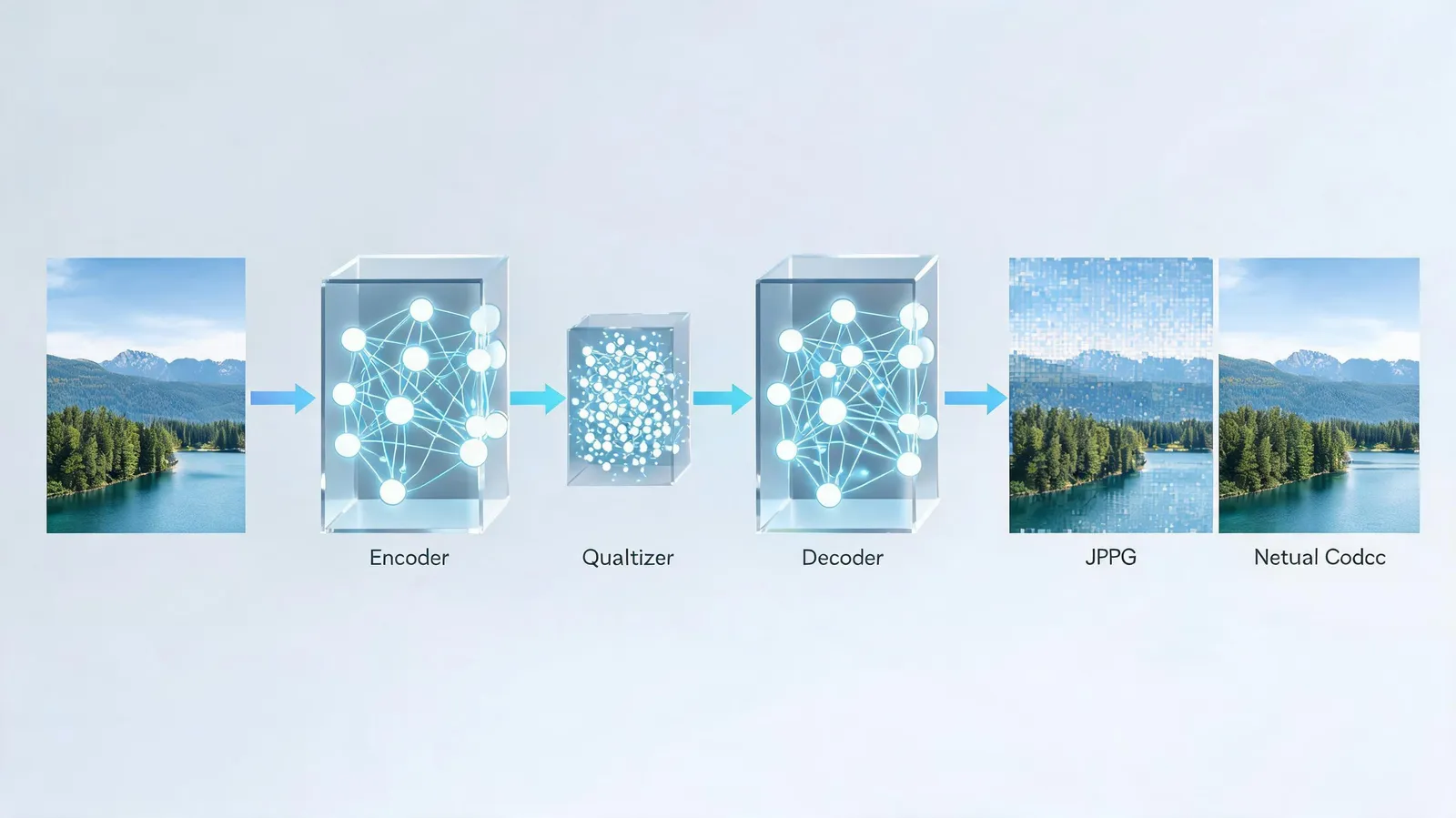
Neural compression breaks with the handcrafted design tradition. Rather than fixed transforms and quantization rules, a learned codec uses deep networks to find compact representations from the data itself. The usual setup has three parts: an encoder that turns the image into a latent representation, a quantizer that discretizes that latent, and a decoder that rebuilds the image. Training is end-to-end against a rate-distortion loss, and perceptual metrics are often folded in.
Work from Google has shown that neural codecs can save up to 30% in bitrate compared with HEVC at the same visual quality. The main reason is adaptability: a network can tune itself to image content and optimize for perceived quality rather than pixel-by-pixel fidelity. High-frequency textures that the eye barely notices may receive fewer bits, while sharp edges and smooth gradients are preserved.
Obstacles remain, though. Neural codecs are computationally heavy, particularly at decode time, which can rule them out for real-time use on mobile devices. Standardization work is in progress within MPEG and JPEG AI to define interoperable neural compression profiles. Compression efficiency also trades off against decoding speed: more complex models compress better but demand more capable hardware. Research continues on lightweight architectures and pruning so that neural codecs become practical at the edge.
2. Measuring Quality the Way People See It

PSNR (Peak Signal-to-Noise Ratio) and SSIM (Structural Similarity Index) have long served as the standard yardsticks for compression algorithms, yet they often diverge from human judgment. Two images with the same PSNR can look very different — one blurry, the other still crisp. The gap exists because PSNR and SSIM work from pixel-level differences and do not model the human visual system.
Learned perceptual metrics such as LPIPS (Learned Perceptual Image Patch Similarity) were developed to close that gap. LPIPS draws on deep features from a pre-trained network (VGG or AlexNet, for example) to compute perceptual similarity. Studies indicate that LPIPS tracks subjective human scores considerably better than PSNR or SSIM. As a result, modern codecs are increasingly tuned with LPIPS or comparable metrics, which yields better visual quality at lower bitrates.
No-reference metrics are also drawing interest. They estimate quality without the original image, which suits real-time streaming and quality monitoring. A no-reference metric can examine a compressed image and infer its perceptual quality from statistical features or deep learning. That is especially valuable in adaptive streaming, where the encoder must decide bitrate allocation quickly without access to the source.
3. Delivering Images Efficiently: Streaming and CDN Techniques
Moving images and video across content delivery networks (CDNs) efficiently matters for bandwidth costs and user experience. Two central techniques are adaptive bitrate streaming (ABS) and per-title encoding. ABS adjusts stream quality to the viewer's network conditions so playback stays smooth without buffering. Per-title encoding, pioneered by Netflix, examines each title and tunes the encoding ladder to that content; Netflix reported a 20% bandwidth saving from the approach.
CDNs add further gains by caching and transcoding at edge servers near users, which cuts latency and backhaul traffic. For image-heavy sites, CDNs can compress images on the fly and serve WebP or AVIF to browsers that support them. Newer protocols such as HTTP/3 and QUIC improve delivery by shortening connection setup and raising throughput, particularly on lossy networks. Paired with advanced compression, they produce faster page loads and less data transfer.
In the United States, large CDN providers including Akamai, Cloudflare, and Amazon CloudFront are adopting these methods. Cloudflare's Image Resizing service, for instance, applies machine learning to optimize compression parameters per image, and Akamai's Image Manager offers automatic format conversion and quality adjustment. Such capabilities matter to media companies, e-commerce platforms, and social networks that serve millions of images daily.
4. Silicon for the Edge: Hardware-Accelerated Compression
With image and video capture now common on edge devices — smartphones, drones, smart cameras — real-time compression that sips power becomes essential. Dedicated hardware blocks in system-on-chips (SoCs) speed up codecs such as HEVC and AV1. Apple's A-series chips, for example, include dedicated ProRes encoders and decoders, and Qualcomm's Snapdragon processors handle real-time 4K encoding. Relative to software implementations, hardware acceleration can cut power consumption by up to 50x, which means longer battery life and cooler operation.
On-device compression also serves privacy and latency. Compressing locally before transmission keeps sensitive data from leaving the device in raw form, and latency drops because uncompressed data need not be sent to the cloud for processing. Examples include smart security cameras that detect motion and compress only relevant frames, drones streaming live video to operators, and phones capturing high-resolution photos and videos.
Hardware acceleration is not free of constraints. Area and power limits in embedded systems cap how complex a hardware codec can be, so designers must weigh compression efficiency against silicon area and energy use. Supporting several codecs in hardware (HEVC, AV1, VP9, for instance) adds design complexity and cost. Research continues on flexible architectures that can be reconfigured for different codecs and quality levels.
Conclusion
Image compression is moving toward a combination of learned codecs, perception-based quality metrics, efficient streaming, and hardware acceleration. Neural codecs extend compression efficiency, perceptual metrics keep the results looking good to human viewers, streaming and CDN advances deliver images quickly and affordably, and hardware acceleration makes it work on power-constrained edge devices. Together they support better user experiences, lower bandwidth costs, and new applications, from immersive AR/VR to real-time surveillance. As AI and hardware evolve, compression systems are likely to become more intelligent and more efficient, shrinking pixels while widening what is possible.