Turning Snapshots into Navigable Worlds: The Rise of Image-Based 3D Reconstruction
A small set of pictures shot on a phone can now be assembled into a three-dimensional environment you can walk through. That capability rests on fast-moving work in reconstructing 3D structure from 2D imagery. Building models by hand has traditionally demanded time and specialist know-how; newer approaches—Neural Radiance Fields, Gaussian Splatting, and photogrammetry among them—take much of that labor out of the loop and shorten the turnaround. Below, we look at the technologies behind this shift, from neural rendering to reconstruction running live on mobile hardware, and at how they are being applied in AR/VR, entertainment, and retail.
1. Neural Radiance Fields and Gaussian Splatting: Emerging Approaches
Neural Radiance Fields (NeRF) mark a notable departure in how 3D scenes are recovered from 2D images. Rather than relying on meshes in the traditional sense, NeRF describes a scene as a continuous volumetric function: 3D coordinates together with viewing direction are mapped to color and density. The result is photorealistic synthesis of viewpoints that were never captured, including demanding effects such as reflections, transparency, and fine surface texture. Researchers have, for instance, reconstructed complex settings—a room containing mirrored surfaces, or a glass sculpture—at a level of detail that was not previously attainable. The cost of this quality is heavy computation and lengthy training, which has acted as a constraint.
Gaussian Splatting has appeared as a speedier option. In this approach a scene is represented explicitly as a set of 3D Gaussians, each carrying position, color, and opacity. Because the representation is explicit, rendering can run in real time—frequently above 30 frames per second on consumer GPUs—while visual quality stays high. In direct comparisons, Gaussian Splatting trains in minutes where NeRF takes hours, and it renders in real time, which suits interactive use. A scene captured with a smartphone, for example, can be reconstructed and displayed in real time on a laptop, which opens the door to live AR/VR experiences. The trade-off is that highly reflective or transparent surfaces can be difficult for Gaussian Splatting; research in progress is narrowing that gap.
2. Photogrammetry and Structure-from-Motion: The Established Base
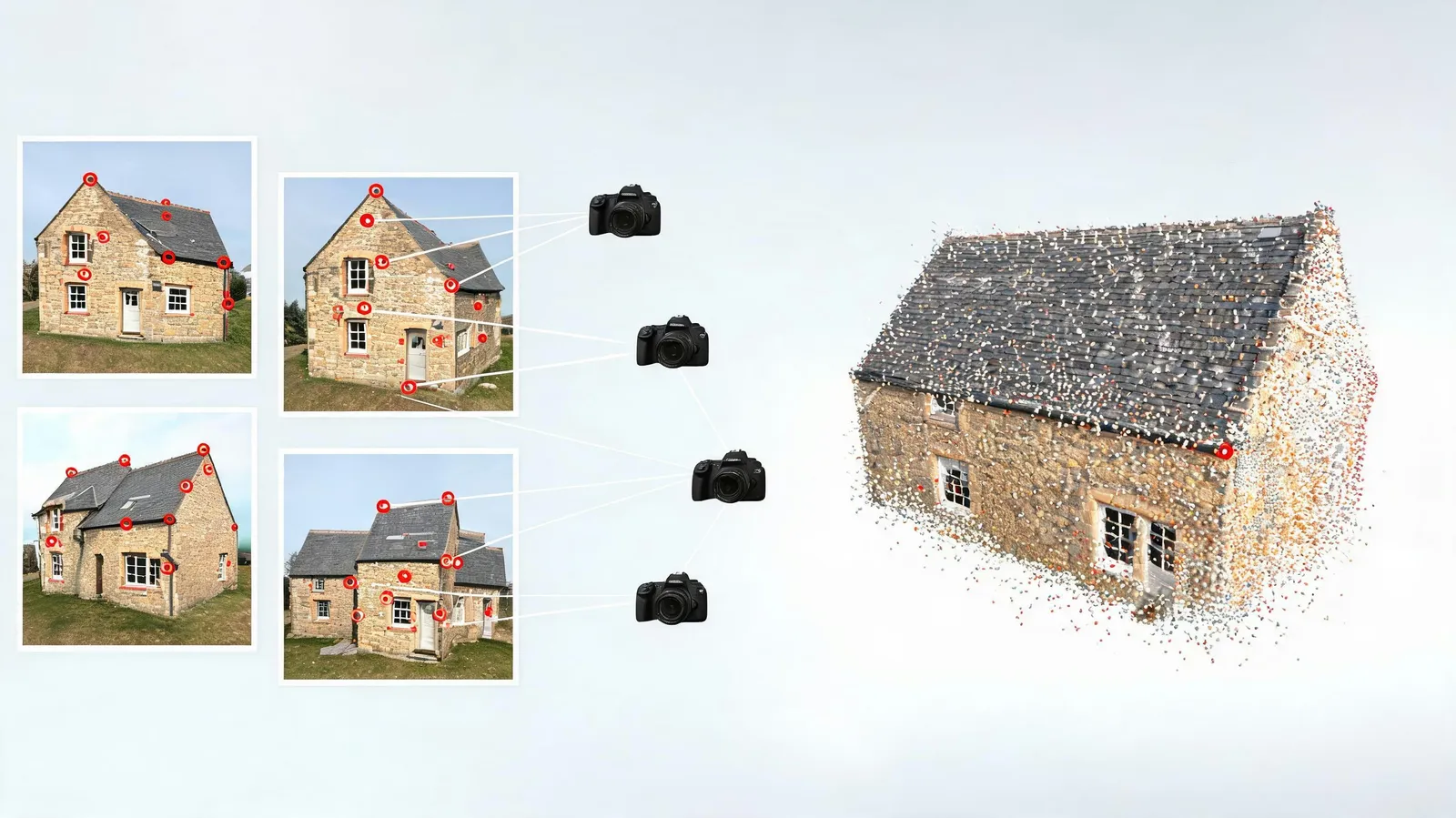
Photogrammetry and Structure-from-Motion (SfM) underpin much of 3D reconstruction from 2D images. SfM derives camera poses and sparse 3D points by matching features across multiple overlapping images. Drone mapping, cultural heritage preservation, and consumer applications such as Google Lens all make use of it. Open-source packages like COLMAP have widened access, so that a set of photos can be turned into a 3D model by anyone. A drone circling a building, for instance, may collect hundreds of images; SfM then computes camera positions and produces a sparse point cloud automatically.
Multi-View Stereo (MVS) carries the process further, yielding dense reconstructions. With calibrated images in hand, MVS algorithms calculate a depth map for each view and merge them into a dense point cloud or mesh. Coupling with deep learning has recently improved depth estimation, particularly in areas lacking texture. Benchmarks such as ETH3D indicate that learning-based MVS methods surpass traditional ones in difficult scenarios. For work that demands high geometric accuracy—surveying or reverse engineering, for example—this established pipeline remains important.
3. AR/VR Content Pipelines: Putting Reconstruction to Work
Folding 3D reconstruction from 2D images into AR/VR workflows is changing how content gets made. Automated asset creation from smartphone captures has become practical: in apps such as IKEA Place, a user can scan a piece of furniture and place a 3D model in their room, cutting manual modeling time from hours to minutes. Google Lens applies comparable technology to recognize objects and overlay AR information. Such examples show how 2D-to-3D reconstruction lowers the barrier to AR/VR content creation, letting small businesses and individuals build immersive experiences without specialist skills.
For interactive AR, reconstruction must keep pace in real time. Latency budgets are tight—commonly under 20 milliseconds—to prevent motion sickness. Microsoft HoloLens and ARKit perform reconstruction on the device to map the surroundings and anchor virtual objects. HoloLens, for instance, combines a depth sensor with visual-inertial odometry to build a mesh of the room as it goes, so holograms can interact with physical surfaces. These developments make AR/VR more immersive and responsive and are a step toward collaborative mixed-reality experiences.
4. Real-Time Reconstruction on Mobile Devices: Obstacles and Advances
Phones bring their own constraints to 3D reconstruction from 2D images: computation, memory, and thermal headroom are all limited. Making neural networks work on mobile calls for methods such as pruning, quantization, and knowledge distillation. MobileNeRF, for example, adapts NeRF to phones through a hybrid representation that lightens the computational load and allows real-time rendering on smartphones. TinyGaussian similarly tunes Gaussian Splatting for mobile GPUs and reaches interactive frame rates. Such advances matter for on-device reconstruction, which can offer privacy advantages and lower latency.
Among the notable steps forward are lightweight neural networks and efficient variants of Gaussian splatting. Smartphone demos show a user scanning a room while a 3D model is built live, with performance readouts indicating 30 FPS and moderate memory use. This supports uses such as mobile 3D scanning for e-commerce, where a shopper can capture a product and inspect it in AR before buying. As mobile NPUs grow more capable, more sophisticated reconstruction on the go can be expected.
Conclusion
Reconstructing 3D from 2D images has advanced considerably, propelled by neural rendering methods such as NeRF and Gaussian Splatting, by established photogrammetry and SfM, by AR/VR pipelines, and by progress on mobile devices. These technologies are widening access to 3D content creation and enabling applications in entertainment, education, and commerce. Looking ahead, likely directions include AI for semantic understanding, real-time collaborative reconstruction, and smoother AR/VR experiences. As the techniques mature, converting flat images into complete 3D worlds may become about as simple as pressing the shutter.