
Introduction
Today's organizations face a conundrum: even with an abundance of collaboration tools, teams are experiencing more meeting fatigue, decision delays, and disengagement than ever. The underlying issue is often not the tools but the organizational design itself. How work is structured—meeting norms, information flow, psychological safety, and hierarchy—determines whether collaboration drives performance or becomes a bottleneck. This article examines four design levers that can transform team collaboration: meeting culture and asynchronous alternatives, cross-functional coordination, psychological safety and feedback loops, and hierarchy flattening. Each lever is backed by real-world examples and data, providing a roadmap for leaders aiming to build agile, innovative teams.
1. Meeting Culture, Decision Speed, and Asynchronous Alternatives
Meetings are the go-to coordination mechanism in most organizations, but their overuse incurs hidden costs: slower decisions, context switching, and less deep work. A 2023 Microsoft study found that the average employee spends 57% of their time in meetings, and 68% report lacking uninterrupted focus time during the workday. These statistics point to a systemic issue: meeting-centric cultures prioritize synchronous interaction over efficient decision-making.
Take the case of a mid-sized tech company that cut its weekly meeting hours by 40% after instituting a 'no-meeting Wednesday' policy and moving status updates to written documents. Within three months, decision speed improved by 25%, and employee satisfaction scores rose by 18%. This example shows that reducing meetings is not about eliminating collaboration—it's about redesigning it.
Asynchronous alternatives provide a powerful solution. Written decision docs, recorded video updates, and structured async check-ins allow team members to contribute on their own schedules, often leading to more thoughtful input and faster consensus. GitLab, a fully remote company with over 1,500 employees, operates entirely asynchronously. Their handbook-first approach ensures that all decisions are documented and accessible, reducing the need for real-time meetings. As a result, GitLab reports a 30% faster decision cycle compared to industry benchmarks.
To implement async work effectively, organizations should establish clear norms: default to written communication, use shared documents for decision proposals, and reserve meetings for complex discussions that truly benefit from real-time interaction. Tools like Notion, Confluence, and Loom can support these practices, but the key is cultural change—rewarding asynchronous contributions as much as meeting participation.
2. Cross-Functional Coordination and Information Flow in Large Organizations
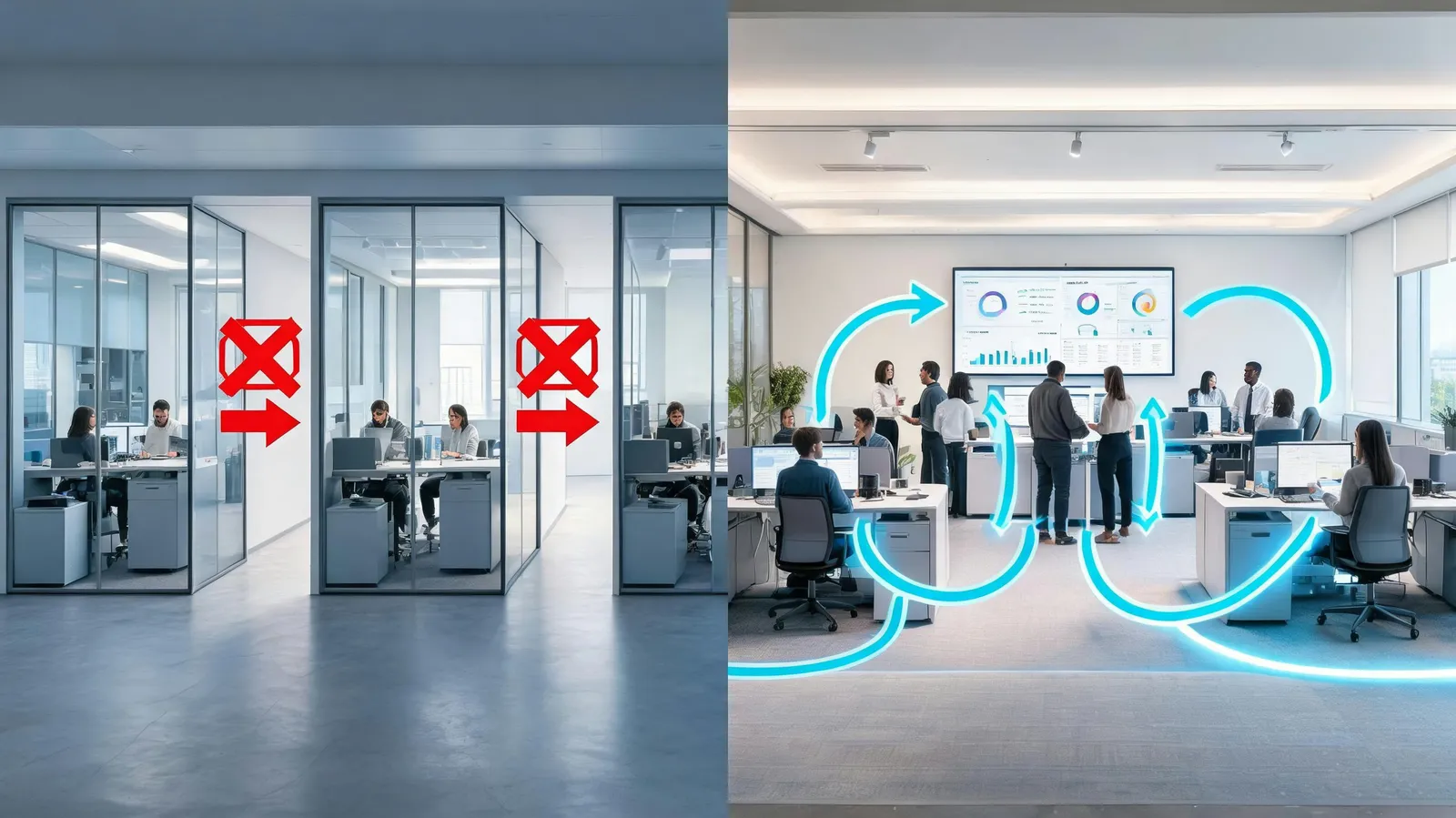
As organizations grow, silos naturally emerge. Departments optimize for their own goals, leading to information bottlenecks, duplicate work, and misaligned priorities. Research from Harvard Business Review estimates that large enterprises lose an average of $62.4 million annually due to poor cross-functional coordination. The design challenge is to create structures that encourage information flow without adding bureaucratic overhead.
One effective design lever is the use of cross-functional task forces. For example, a Fortune 500 consumer goods company created an 'innovation squad' comprising members from R&D, marketing, supply chain, and finance. By co-locating these individuals and giving them shared goals, the company reduced project delays by 30% and brought new products to market twice as fast. Similarly, matrix structures—where employees report to both functional and project managers—can improve coordination, but they require clear role definitions and conflict resolution mechanisms to avoid confusion.
Another lever is transparent information radiators: dashboards, shared metrics, and open communication channels that make work visible across functions. When everyone can see project status, dependencies, and blockers, coordination becomes proactive rather than reactive. Companies like Spotify use autonomous squads with shared dashboards to align efforts without constant meetings. The key is to design information flow so that it naturally reaches those who need it, reducing the need for constant check-ins.
3. Psychological Safety, Feedback Loops, and Team Learning
Psychological safety—the belief that one can speak up without punishment—is the foundation of effective collaboration. Google's Project Aristotle, a two-year study of 180 teams, found that psychological safety was the single most important factor in team effectiveness, outweighing individual talent and seniority. Teams with high psychological safety are 27% more likely to report higher innovation and 22% less likely to experience turnover.
To build psychological safety, organizations must design feedback loops that normalize open communication. Structured retrospectives, after-action reviews, and peer coaching sessions provide regular opportunities for team members to share concerns and ideas. For instance, a software development team at a healthcare company implemented weekly retrospectives and saw error rates drop by 25% within six months. The retrospectives were not about blame but about learning—each session ended with actionable improvements.
Peter Senge's concept of the learning organization emphasizes that teams must continuously adapt and learn. Design elements that support this include: safe-to-fail experiments, where teams can test ideas without fear of retribution; blameless post-mortems after failures; and peer feedback systems that are constructive rather than evaluative. When these practices become part of the organizational routine, collaboration shifts from transactional to transformative.
4. Flattening Hierarchies, Delegation, and Bottleneck Removal
Tall hierarchies create decision bottlenecks. When every decision requires multiple approvals, teams lose autonomy and speed. A study by Bain & Company found that companies with more than five hierarchical layers take 30% longer to make decisions than flatter organizations. Moreover, excessive layers disempower frontline employees, leading to lower engagement and slower response to market changes.
Flattening hierarchies is not about eliminating structure but about redistributing decision rights. Companies like Valve, with its flat lattice organization, and Zappos, with its holacracy experiment, have demonstrated that self-managed teams can thrive when given clear goals and boundaries. Haier, the Chinese appliance giant, famously removed middle management layers and reorganized into thousands of self-managed microenterprises, resulting in a 30% increase in innovation output and faster time-to-market.
Design strategies for flattening include: delegated decision rights, where teams are empowered to make decisions within defined guardrails; self-managed teams with clear accountability; and escalation paths that are transparent and time-bound. For example, a financial services firm reduced its approval layers from seven to three and saw decision velocity improve by 40%. The key is to balance autonomy with alignment—ensuring teams understand strategic priorities while having the freedom to execute.
Conclusion
Rethinking team collaboration requires intentional organizational design. Meeting culture, cross-functional coordination, psychological safety, and hierarchy flattening are not independent fixes but interconnected levers that together determine how well teams perform. By reducing meeting overload and embracing asynchronous work, organizations can speed up decisions. By breaking down silos and fostering cross-functional coordination, they can improve information flow. By building psychological safety and feedback loops, they can unlock learning and innovation. And by flattening hierarchies and delegating decision rights, they can remove bottlenecks and empower teams.
Organizational design is not a one-time project but an ongoing practice. As AI and asynchronous tools continue to evolve, leaders must continuously experiment with new design principles. The future of work belongs to organizations that treat collaboration as a design challenge—not just a cultural aspiration. By applying the levers discussed in this article, leaders can build teams that are not only more productive but also more adaptable, innovative, and fulfilling.