Gauging AI Workflow Performance: Metrics That Matter
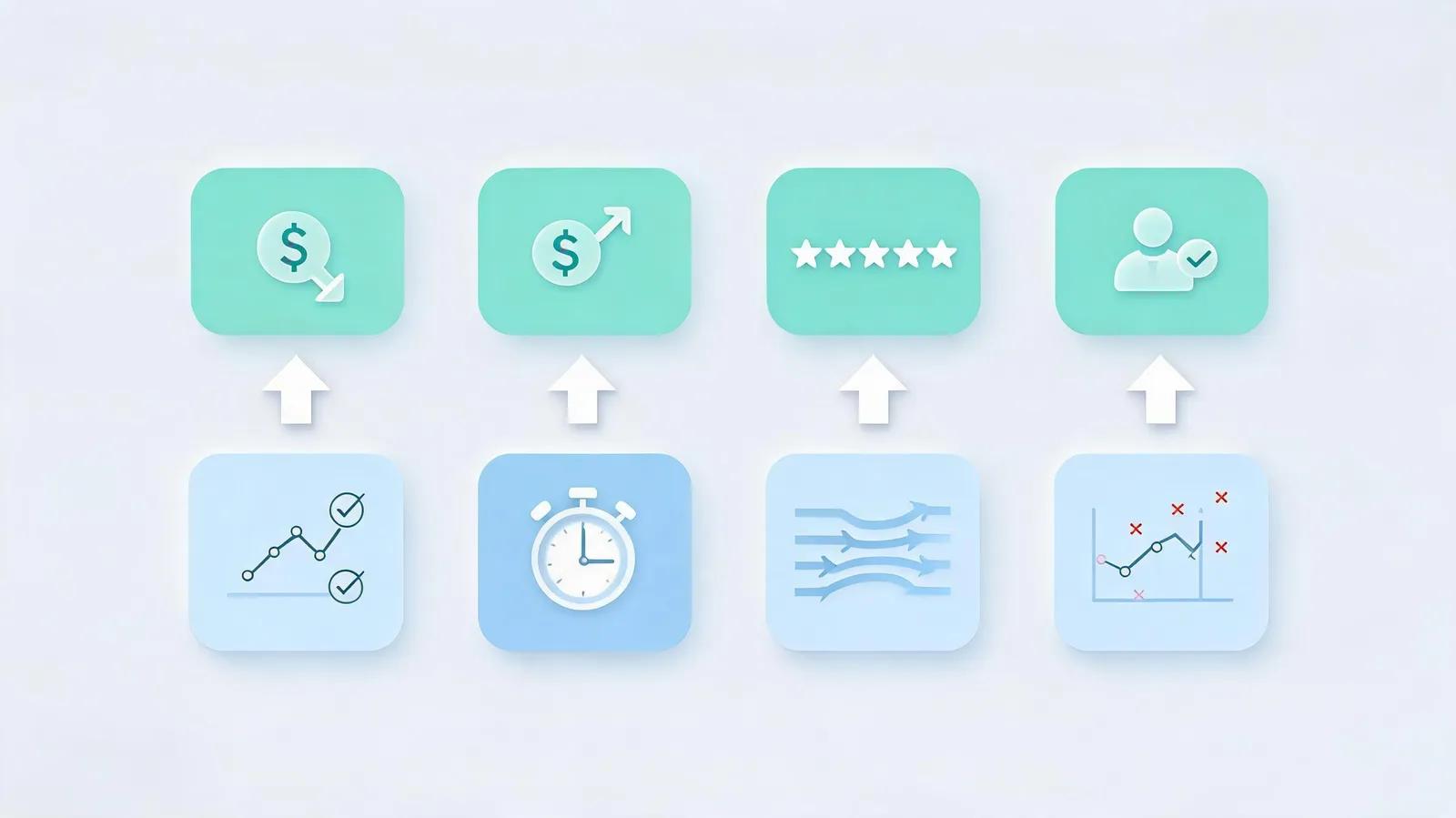
Success for an AI workflow has to be judged on two fronts at once: how well the technology performs and what it does for the business. On the technical side, you need figures for accuracy, response time, processing capacity, and failure frequency. On the business side, the signals that count are money saved, revenue influenced, customer satisfaction, and employee output. When these two layers are tied together, AI efforts are more likely to produce outcomes you can point to.
Technical measures form the base layer. Accuracy tells you how often predictions are right; latency captures how quickly the system responds; throughput shows how much work it can handle; error rates reveal how often things go wrong. One financial services company, for instance, cut its model error rate by 15% through disciplined testing, and customer satisfaction rose 10% as a result. Such indicators are what let teams diagnose problems and tune the model.
Business KPIs convert technical results into organizational worth. Savings from automation, revenue growth tied to better customer experiences, and productivity gains from smoother processes are direct signs of return. Research from Deloitte found that companies which track AI KPIs are 2.5 times as likely to report a meaningful business impact. A dashboard combining technical and business measures gives real-time visibility and supports better decisions.
Weighing the Costs and Benefits of AI

Before committing, a careful cost-benefit review is needed to judge whether an AI workflow makes financial sense. On the cost side you have development, deployment, maintenance, training, and opportunity costs. Development covers gathering data, building models, and testing; deployment covers infrastructure and integration; maintenance covers updates and monitoring; training covers getting users comfortable with the system; and opportunity costs reflect resources pulled away from other work. Because of unforeseen complexity, a typical AI project can run 20-30% over budget, which is why contingency planning matters.
On the benefit side are efficiency gains, added revenue, reduced risk, and strategic advantage. Automation can shorten processing time by as much as 50%, while revenue growth tends to come from more personalized customer experiences. Predictive analytics that lower risk can avoid millions in compliance penalties. Strategic advantages include standing out from competitors and the ability to scale. One retail company, for example, saw a 200% ROI within two years after deploying AI for demand forecasting; inventory costs fell 15% and sales rose 10%.
The ROI formula is: (Net Benefits / Total Costs) x 100. A positive result signals financial viability, though qualitative gains such as better decision-making deserve weight too. Revisiting the analysis on a regular basis keeps it aligned with shifting business priorities.
Keeping AI Workflows Performing Over Time
AI workflows cannot be left to run unattended; they need ongoing monitoring and tuning to hold their performance. Real-time dashboards, alerting systems, and feedback loops from users are key to catching problems such as model drift, where predictive accuracy slips over time. A healthcare AI system watching patient data, for example, detected a drift in diagnostic accuracy; retraining was triggered, performance was restored, and uptime improved by 30%.
Iterative optimization covers A/B testing, retraining models, and refining processes. A/B testing pits model variants against each other to find the stronger performer; retraining on fresh data keeps the model relevant; process refinement smooths integration. A logistics company case study showed that ongoing optimization produced a 20% efficiency gain over six months. Among the practices worth adopting: building a feedback culture, automating retraining pipelines, and using AI observability tools to understand how models behave.
Continuous improvement is less a one-off project than a cultural change. Organizations that take it on can respond to shifting market conditions and draw new value from their AI investments.
Final Thoughts
Assessing the ROI and performance of AI workflows is more than a technical task—it is a strategic necessity. Clear metrics, disciplined cost-benefit analysis, and a commitment to ongoing improvement let organizations confirm that their AI spending produces real business value. Observability and automation point to where AI is heading, with tools that track ROI automatically and surface optimization opportunities. A measurement-first mindset is how AI hype gets converted into results that hold up.