Intelligent Document Processing: Extracting Value from Unstructured Data
Intelligent document processing (IDP) uses AI technologies like optical character recognition (OCR) and natural language processing (NLP) to automatically classify documents and extract relevant data. This removes manual data entry, reduces errors, and speeds up downstream processes.
AI-Powered OCR and NLP for Document Classification and Data Extraction
Traditional OCR only captures text, but AI-powered OCR understands context, handles various formats, and extracts structured data from invoices, contracts, and forms with high accuracy. For instance, in invoice processing, AI can extract vendor names, amounts, and due dates, achieving accuracy rates above 99%, compared to manual entry which averages 95% with higher error rates.
Integration with Business Systems for Seamless Data Flow
Extracted data is integrated into ERP and CRM systems, enabling straight-through processing. A case study of a financial institution revealed a 70% reduction in invoice processing time and a 50% decrease in data entry errors after implementing IDP.
Automated Decision-Making in Customer Service: Beyond Chatbots

AI-driven decision engines go beyond simple chatbots by making real-time decisions on routing, prioritization, and resolution. These systems analyze customer inquiries, assess urgency, and route cases to the appropriate agents or automated solutions, reducing response times by up to 60%.
AI-Driven Decision Engines for Routing, Prioritization, and Resolution
For example, dynamic case routing uses AI to direct high-value or urgent cases to specialized agents, improving first-contact resolution. A telecom company implemented AI decision engines and saw a 40% increase in customer satisfaction scores due to faster and more personalized responses.
Personalized Recommendations and Proactive Customer Engagement
AI also enables personalized recommendations and proactive engagement by analyzing customer history and predicting needs. This leads to higher upsell opportunities and improved loyalty.
End-to-End Process Orchestration with AI Agents: The Future of Work
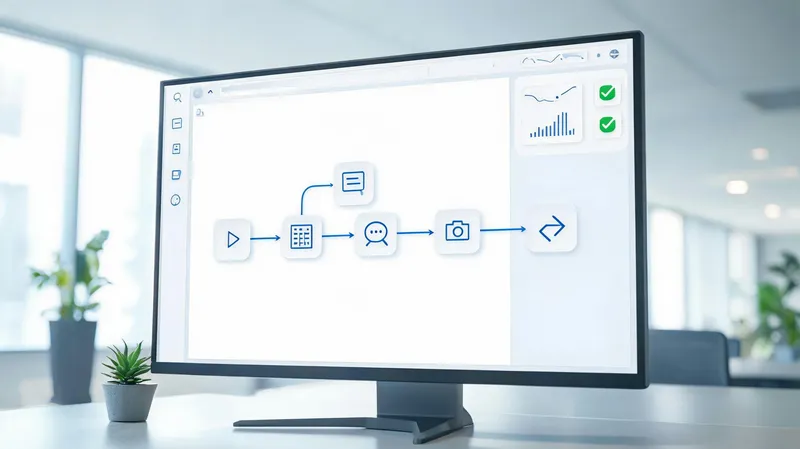
AI agents act as orchestrators of complex workflows, coordinating tasks across multiple systems and humans. They can automate entire processes, such as order-to-cash, by integrating with ERP, CRM, and communication tools.
AI Agents as Orchestrators of Complex Workflows Across Systems
For example, in an order-to-cash process, AI agents can receive orders, check inventory, generate invoices, and initiate collections, reducing errors by 80% and cycle time by 50%. A supply chain optimization case study showed AI agents improving forecast accuracy by 30% through continuous learning.
Continuous Learning and Adaptation of AI Agents
AI agents continuously learn from process data, adapting to changing conditions and optimizing workflows over time, leading to self-optimizing business processes.
Conclusion
AI workflow automation, through intelligent document processing, automated decision-making, and AI agents, enables end-to-end process orchestration, driving significant efficiency gains and competitive advantage. Organizations must adapt to this transformative trend to stay ahead.