AI Coding Assistants Enter the Classroom
Across US universities and coding bootcamps, code-generating assistants are now a routine part of introductory and advanced programming instruction. These systems go beyond the conventional integrated development environment: they can produce complete functions, propose corrections, and describe code in everyday language. The debate among instructors has therefore shifted from whether such tools belong in class to how they can be used without weakening core skills.
Adaptive Feedback Resembling One-on-One Instruction
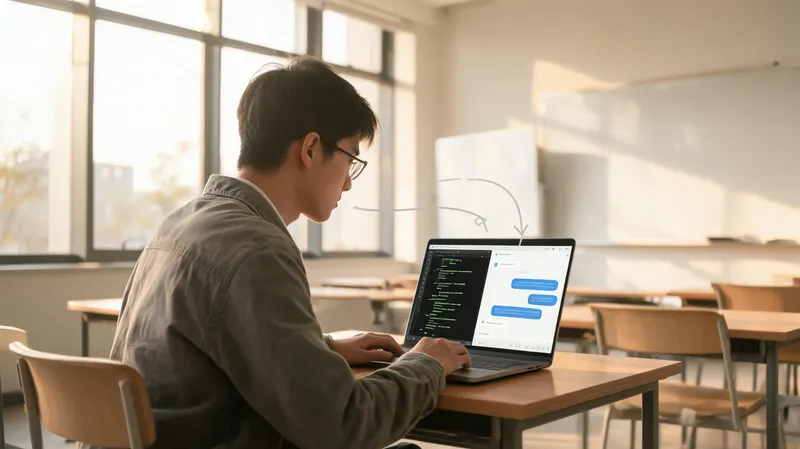
Work at Stanford University and MIT indicates that learners who use AI coding assistants finish tasks more quickly and introduce fewer syntax errors. The more significant benefit is adaptive guidance that approximates individual tutoring. If a student is stuck on recursion, for instance, the assistant can break the concept into steps or supply a simpler illustration. A study presented at the 2023 ACM Conference on Learning at Scale reported that novices using such assistants improved code correctness on weekly assignments by 20–30% relative to a control group.
Rethinking Exams and Coursework
The upside comes with a need to redesign assessment. Tests that require students to write code from scratch may no longer give an accurate picture of learning when AI can produce comparable solutions. Harvard's CS50 has taken a two-track approach: AI tools are permitted for homework, while core concepts are tested in person without AI. Other programs are moving toward project work that judges design choices, code-review ability, and skill at debugging AI-generated output. A 2024 survey by the Computing Research Association found that 68% of US computer science departments were revising academic integrity policies to account for AI-generated code.
Lowering the Entry Barrier for Non-Programmers and Domain Experts

Perhaps the most consequential effect of these tools is that people without software engineering training can now produce working code. By turning plain-language descriptions into executable programs, assistants let analysts, scientists, clinicians, and other specialists automate work that once required a dedicated developer.
Describing Software in Plain English
GitHub Copilot Chat and Replit's Ghostwriter, among others, accept instructions written in ordinary English—for example, a request to read a CSV file, keep rows where sales exceed $10,000, and draw a bar chart—and return the corresponding Python or JavaScript. Case studies from the University of California, Berkeley's data science program found that business analysts with no formal programming background built custom dashboards and automated reporting within days. A 2024 GitHub survey reported that 45% of Copilot users describe themselves as non-developers, a group that includes data analysts, researchers, and product managers.
Domain Specialists Automating Their Own Work
In research settings, biologists can now write genomic analysis scripts without bringing in a programmer. A 2023 article in Nature Biotechnology described oncologists who used an AI assistant to generate Python for analyzing patient imaging data, cutting a task that would have taken weeks down to a few hours. In healthcare, physicians are likewise building small tools for patient triage and appointment scheduling. The pattern points to a broader shift: coding assistants are broadening access to programming, letting experts concentrate on problems in their own field instead of on syntax.
What AI Means for Junior Developers and Entry-Level Hiring
Expectations for junior developers are shifting as AI assistants become standard. Employers increasingly assume that entry-level hires will lean on these tools for boilerplate code, debugging, and even parts of system design. Both the skills in demand and the content of entry-level job listings are changing as a result.
A Different Skill Mix
A 2024 Stack Overflow survey found that 72% of professional developers already use AI coding assistants regularly. For junior positions, the premium is moving from memorized syntax toward prompt engineering, code review, and awareness of where AI falls short. Employers say they value candidates who can scrutinize AI-generated code for security flaws, performance problems, and maintainability. A 2024 report from the Burning Glass Institute found that entry-level developer postings increasingly list "experience with AI-assisted development tools" as a preferred qualification.
A Changing Job Market
Fears that AI will wipe out junior roles are not borne out by current data, which shows a more complicated picture. The US Bureau of Labor Statistics projects 15% growth in software developer employment between 2023 and 2033, though the content of entry-level work is shifting. Instead of building simple CRUD applications, juniors are more likely to integrate AI-produced code, write tests, and work alongside AI to ship features faster. Shopify and Duolingo are among the companies that have said publicly they expect new hires to be comfortable with AI assistants. The central challenge is making sure junior developers still build deep problem-solving ability instead of leaning on AI too heavily.
Ethics, Attribution, and Academic Integrity
AI coding assistants raise difficult questions about plagiarism, attribution, and academic integrity. Because these systems are trained on large collections of open-source code, generated output may at times reproduce licensed or copyrighted material without proper credit.
Tracing the Source of Generated Code
A 2023 study by researchers at the University of California, Santa Barbara, found that AI coding assistants sometimes produce code nearly identical to existing open-source projects, which raises license-compliance concerns. For students, submitting AI-generated code without disclosure can count as plagiarism under many university honor codes. Carnegie Mellon University is among the institutions that now require students to cite AI assistance in assignments, much as they would cite a textbook or a tutor. The difficulty is that AI-generated code often cannot be traced to a single source, which complicates attribution.
Building Ethical Frameworks and Policies
Universities and companies are drafting ethical frameworks for AI-assisted coding in response. The Association for Computing Machinery (ACM) issued updated guidelines in 2024 that recommend teaching students to use AI responsibly, including awareness of bias, privacy, and security implications. Some US universities have adopted honor pledges under which students agree to disclose AI use and not to submit AI-generated code as their own. In industry, Google and Microsoft are among the companies with internal policies requiring developers to check AI-generated code for security and licensing problems before committing it. A common best practice is to keep a human in the loop, treating AI as an aid rather than a substitute.
Conclusion
AI coding assistants are not a temporary trend; they are changing programming education, access to coding, and the developer workforce in fundamental ways. In classrooms they offer individualized guidance and faster progress, but they also require new forms of assessment and updated integrity rules. For non-programmers and domain experts, they remove barriers and make automation possible, spreading coding capability across disciplines. For junior developers, they push the skill set toward collaboration with AI and code review while still demanding strong problem-solving. On the ethical side, they raise attribution and plagiarism questions that institutions have only started to confront.
The educators and employers most likely to succeed will be those who adapt deliberately: embedding AI tools in curricula, teaching responsible use, and redefining what skilled development means when AI is part of the workflow. As the technology evolves, it could further broaden access to programming and open new opportunities—so long as the risks are managed through thoughtful policy and sustained human oversight.