
Introduction
Tools like GitHub Copilot, Amazon CodeWhisperer, and Tabnine are reshaping enterprise software development. Developers are seeing notable productivity improvements, and organizations are keen to shorten delivery cycles. Yet this swift uptake frequently runs ahead of the governance structures required to manage the resulting risks. Enterprises must balance innovation with compliance obligations under regulations such as GDPR, HIPAA, and SOC2, while also maintaining auditability of generated code and protecting sensitive data. Without a solid governance strategy, organizations face exposure to security weaknesses, intellectual property conflicts, and regulatory sanctions. This article lays out a comprehensive framework for governing AI code generation, organized around four critical pillars: enterprise policies, compliance and auditability, vendor evaluation, and change management. By addressing these areas, enterprises can capture the benefits of AI code generation while reducing its risks.
1. Enterprise Policies for AI Code Generation Tools
Clear policies form the bedrock of any governance framework. Enterprises need to define acceptable use, prohibited practices, and enforcement mechanisms to guide developers and ensure accountability.
1.1 Acceptable Use and Prohibited Practices
Organizations should explicitly specify which types of code may be generated by AI and which are off-limits. For example, security-critical code—such as authentication modules, encryption algorithms, or payment processing logic—may be restricted from AI generation due to the high risk of vulnerabilities. Similarly, code subject to regulatory compliance (e.g., HIPAA in healthcare, PCI-DSS in finance) should be carefully reviewed or excluded. Policy templates from industry leaders often categorize code by risk level: low-risk (e.g., UI components), medium-risk (e.g., business logic), and high-risk (e.g., security, data handling). Prohibited practices may include using AI to generate code that infringes on third-party licenses or bypasses security controls.
1.2 Intellectual Property and Licensing Considerations
AI models are trained on vast datasets that may include copyrighted code. Enterprises must assess the risk of training data provenance and establish guidelines for attribution and ownership. Some vendors offer indemnification against IP claims, but the scope varies. Policies should require developers to review AI-generated code for potential license violations and document the origin of any third-party snippets. Tools that scan for license compatibility can be integrated into the development pipeline.
1.3 Enforcement and Monitoring Mechanisms
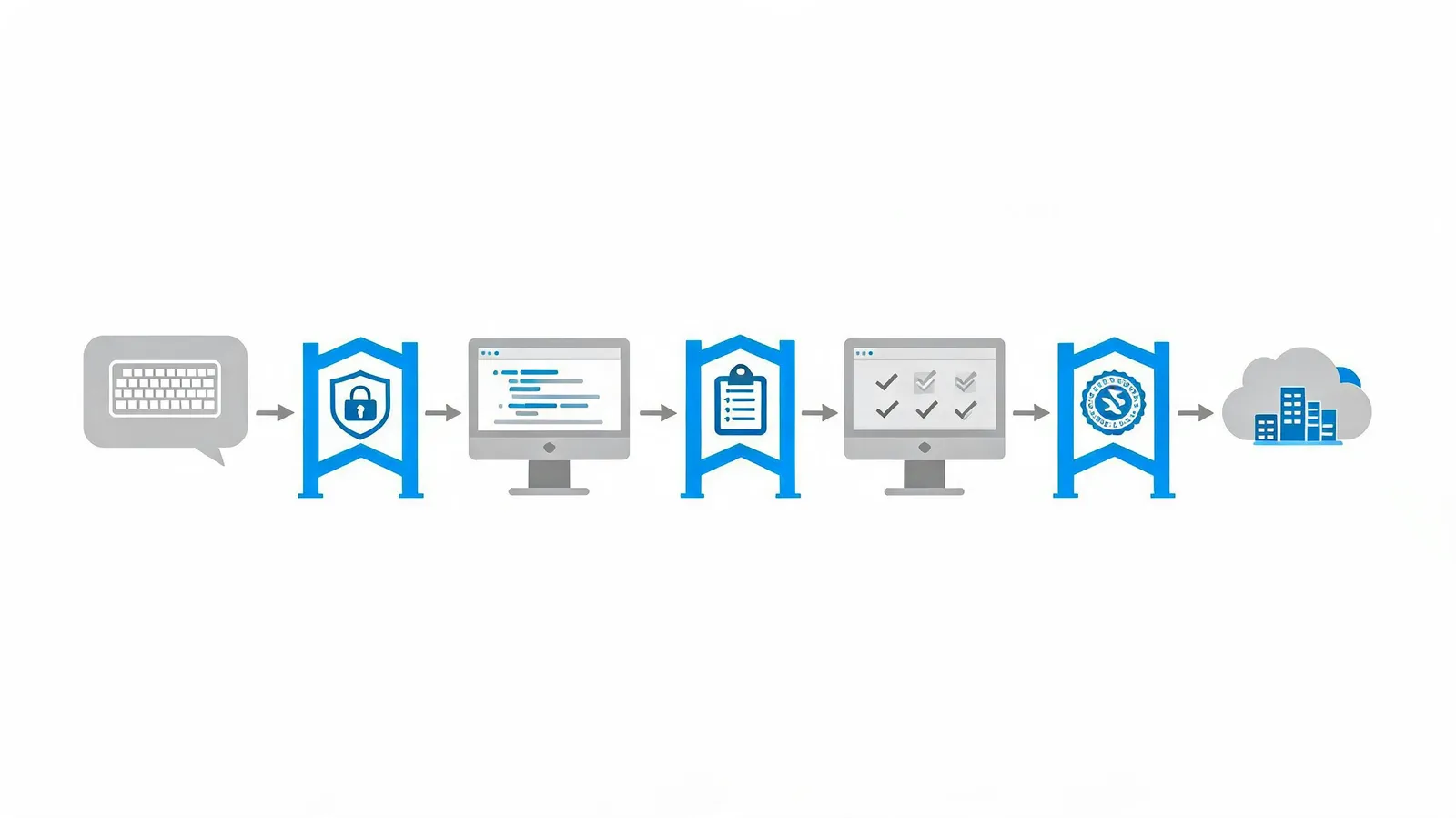
Policies are only effective if enforced. Enterprises should implement automated policy checks within CI/CD pipelines to flag violations before code is merged. For instance, static analysis tools can detect prohibited code patterns or license issues. Additionally, audit trails for AI-generated code—logging prompts, model versions, and outputs—are essential for traceability and incident response. Regular audits and developer training reinforce compliance.
2. Compliance, Auditability, and Data Privacy
Ensuring that AI code generation meets regulatory and internal compliance requirements is non-negotiable, especially in regulated industries.
2.1 Regulatory Compliance (GDPR, HIPAA, SOC2, etc.)
Different regulations impose specific obligations. GDPR requires data protection impact assessments (DPIAs) for processing personal data; AI code generation that handles EU citizen data must be assessed. HIPAA mandates safeguards for protected health information (PHI); AI tools generating code for healthcare applications must comply. SOC2 requires controls around security, availability, and confidentiality. Enterprises should map AI code generation activities to these requirements and conduct DPIAs where necessary. A case study from a healthcare provider illustrates how they restricted AI generation for PHI-related code and implemented additional reviews.
2.2 Auditability of AI-Generated Code
Auditability means being able to trace the origin and changes of code. For AI-generated code, this includes logging the prompt, the model used, the timestamp, and the developer who accepted the suggestion. Tools for code provenance, such as those that embed metadata in commits, can help. Review processes should include checks for AI-generated code, and audit trails must be immutable and accessible for compliance reviews.
2.3 Data Privacy and Isolation
AI code generation tools may send code snippets to cloud services, raising data leakage risks. Enterprises must choose deployment models that align with their privacy requirements: on-premise solutions offer maximum isolation, while cloud-based services may offer private instances or data encryption. Techniques for anonymizing training data, such as differential privacy, are emerging but not yet widespread. Policies should prohibit sending sensitive data (e.g., API keys, personal data) to AI tools.
3. Vendor Evaluation and Build-vs-Buy Decisions
Selecting the right AI code generation solution requires careful evaluation of vendors or building an in-house solution.
3.1 Key Evaluation Criteria for Vendors
When evaluating vendors, consider security certifications (e.g., SOC2, ISO 27001), model transparency (can you understand how the model was trained?), integration capabilities (IDE support, CI/CD integration), and indemnification terms. A comparison matrix of leading vendors—GitHub Copilot, Amazon CodeWhisperer, Tabnine, and others—should include factors like data retention policies, customizability, and cost. Enterprises should also assess vendor roadmaps and financial stability.
3.2 Build-vs-Buy Trade-offs
Building an in-house AI code generation tool offers maximum control over data and customization but requires significant investment in ML expertise and infrastructure. Buying a commercial solution is faster and often more cost-effective but may lack specific customizations. Enterprises must weigh cost, control, time-to-value, and strategic importance. For example, a large tech company might build to integrate with proprietary systems, while a smaller firm might buy to accelerate adoption.
3.3 Pilot and Proof-of-Concept Strategies
Before full-scale deployment, run a pilot with a small team. Define success metrics such as code quality (e.g., defect density), developer productivity (e.g., time to complete tasks), and security incident rates. Mitigate risks during trials by limiting access to sensitive code and monitoring outputs. A successful pilot provides data to inform broader rollout decisions.
4. Change Management and Team Adoption Strategies
Technology alone is not enough; people and processes must adapt. Change management is critical for successful adoption.
4.1 Training and Upskilling Developers
Developers need training on how to effectively use AI code generation tools, including prompt engineering and critical review of AI-generated code. Curriculum examples include workshops on writing effective prompts, identifying biases or vulnerabilities in generated code, and integrating AI into existing workflows. Metrics show productivity gains after training, such as reduced time spent on boilerplate code.
4.2 Addressing Resistance and Building Trust
Resistance often stems from fear of job displacement or distrust of AI. Communication strategies should emphasize augmentation, not replacement, and highlight how AI can eliminate tedious tasks. Champions programs—identifying early adopters who advocate for the tools—can build trust. Surveys on developer sentiment should be conducted regularly to address concerns.
4.3 Integrating AI into Existing DevOps Pipelines
Integrate AI code generation into CI/CD pipelines seamlessly. Best practices include automating code reviews for AI-generated code, using policy checks as gates, and ensuring that AI tools are compatible with existing version control and build systems. A case study of a successful rollout at a financial services firm shows how they integrated AI suggestions into their IDE and CI/CD, resulting in a 20% reduction in development time.
Conclusion
Governing AI code generation is not about hindering innovation; it's about enabling it safely. By establishing clear enterprise policies, ensuring compliance and auditability, carefully evaluating vendors, and managing change effectively, organizations can unlock the productivity benefits of AI while mitigating risks. These four pillars are interconnected: policies inform compliance requirements, vendor choices affect auditability, and change management ensures adoption. As AI technologies and regulations evolve, governance frameworks must adapt. Enterprises that proactively build governance will be better positioned to leverage AI code generation as a strategic advantage, turning the code revolution into a controlled and beneficial transformation.