
Introduction: Why Debugging AI Is Different
In conventional software, debugging follows a clear path: pause execution, examine state, follow the call stack. Large language models upend that approach. Their behavior is probabilistic, their internals are hard to inspect, and even a minor wording change in the input can produce a completely different response—sometimes turning a correct answer into an invented one. As generative AI shifts from demonstration projects to live systems, teams encounter a range of new failure modes, including prompt sensitivity, hallucination, and intricate interactions among multiple agents. Effective debugging of LLM applications draws on established software engineering practices, prompt design expertise, and fresh evaluation methods to create systems that are dependable, safe, and useful.
1. Addressing Prompt Sensitivity and Hallucination
Prompt sensitivity refers to an LLM's propensity to generate markedly different outputs for prompts that mean the same thing. This characteristic makes reproducibility difficult. The first step toward mitigation is understanding why small prompt modifications lead to large output differences.
1.1 Prompt Sensitivity: Origins and Measurement
Prompt sensitivity stems from the model's training on varied text, where minor phrasing changes trigger different latent patterns. For instance, changing “Summarize this article” to “Give a summary of this article” can produce outputs that differ in length and emphasis. To quantify sensitivity, apply prompt perturbation: create several paraphrases of a prompt, pass them through the model, and calculate a sensitivity score based on output divergence (e.g., BLEU, ROUGE, or embedding similarity). Sensitivity scoring techniques help put a number on this instability.
1.2 Finding and Mitigating Hallucinations
Hallucinations are outputs that are stated confidently but are factually wrong. Detection approaches include self-consistency (sampling multiple outputs and checking agreement), fact-checking against knowledge bases, and uncertainty quantification (e.g., token-level log probabilities). One case study: a question-answering system cut its hallucination rate by 40% by combining self-consistency with a retrieval-based fact-checker. To reduce hallucinations, ground prompts in retrieved evidence, use chain-of-thought with verification steps, and fine-tune on domain-specific data.
2. Evaluating and Debugging Retrieval-Augmented Generation Pipelines
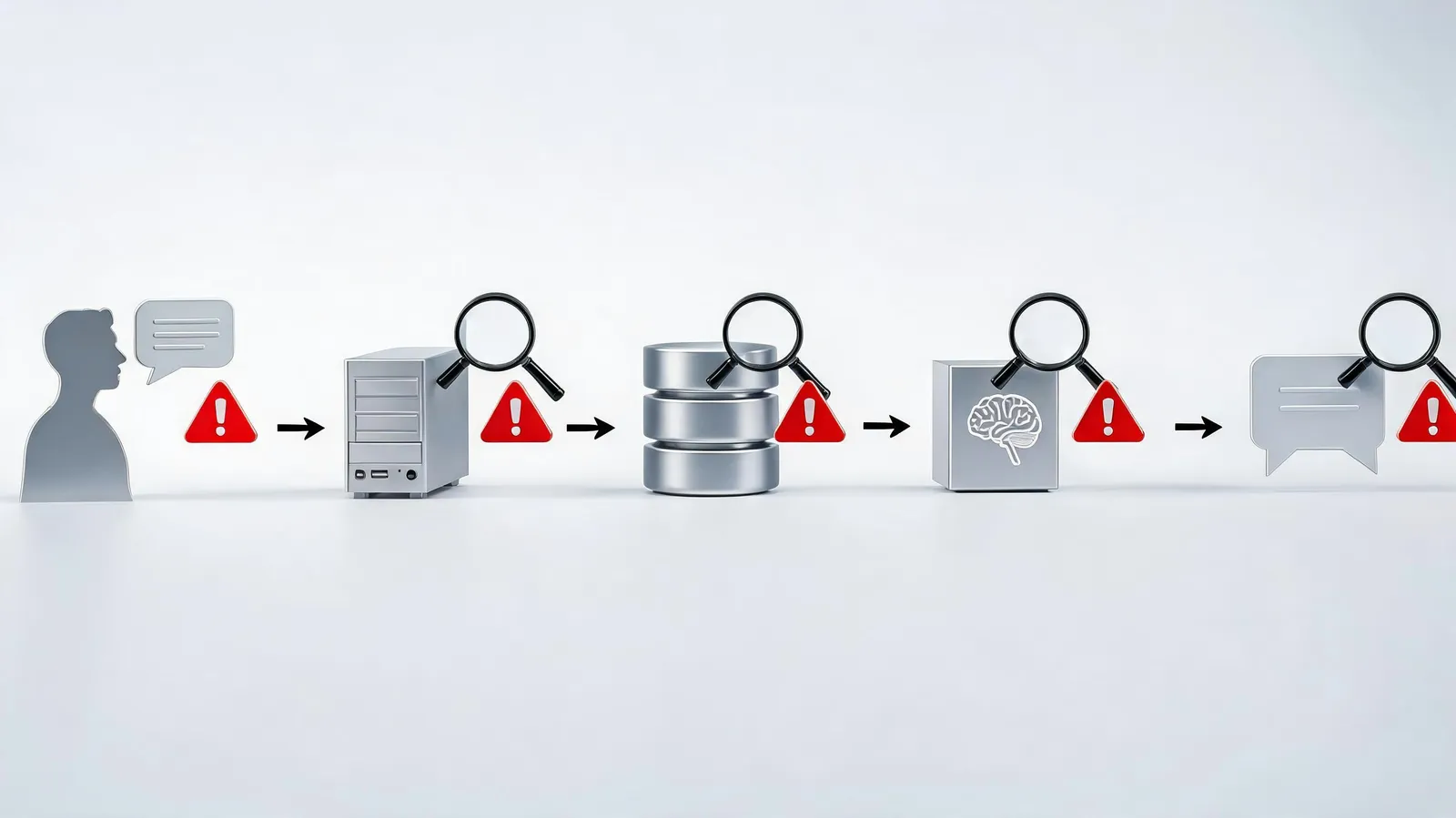
RAG systems pair a retriever with an LLM to anchor answers in external knowledge. Debugging them requires a systematic approach that spans retrieval and generation.
2.1 Frequent RAG Failure Modes: Retrieval Misses, Irrelevant Context, and Generation Drift
Retrieval misses happen when the retriever fails to fetch relevant documents because of embedding issues or poor chunking. Irrelevant context occurs when retrieved passages are off-topic, which confuses the LLM. Generation drift is when the LLM disregards retrieved context and fabricates information. Metrics to monitor include retrieval precision/recall, answer relevance, and faithfulness. For example, a retrieval failure caused by embedding mismatch can be diagnosed by comparing query and document embeddings.
2.2 Debugging Approaches: Component-Wise Testing and End-to-End Evaluation
Debug RAG by testing components separately: first evaluate the retriever using precision/recall, then assess the generator with faithfulness metrics. Tools such as Ragas, TruLens, and custom evaluation harnesses can automate this process. A case study: RAG accuracy improved by 30% through better chunking (semantic chunking) and re-ranking retrieved results with a cross-encoder.
3. Debugging Multi-Agent and Tool-Using AI Systems
Multi-agent systems bring emergent behaviors, communication failures, and tool misuse. Debugging them resembles debugging a distributed system with unpredictable actors.
3.1 Challenges: Emergent Behaviors, Communication Breakdowns, and Tool Misuse
Agents may get stuck in loops, misinterpret instructions, or misuse tools (e.g., calling an API with wrong parameters). Logging and tracing agent interactions is essential. For example, a customer service bot with multiple agents might have one agent repeatedly ask for clarification because of a misunderstood handoff.
3.2 Debugging Techniques: Simulation, Step-by-Step Replay, and Agent Introspection
Use frameworks like LangSmith or AutoGen debugging tools to trace agent conversations. Simulation with synthetic inputs helps reproduce bugs. Step-by-step replay allows inspecting each agent's state. Agent introspection—asking an agent to explain its reasoning—can reveal misinterpretations. Case study: resolving a multi-agent coordination bug in a customer service bot by adding a shared memory and explicit role definitions.
4. Red-Teaming and Adversarial Debugging for Generative Models
Red-teaming is proactive debugging: simulating attacks to uncover vulnerabilities before deployment.
4.1 Red-Teaming and Its Importance for Generative AI
Red-teaming involves adversarial testing for prompt injection, jailbreaking, and data leakage. It is essential for safety, ethics, and regulatory compliance. Examples: a prompt injection attack can override system instructions, while jailbreaking bypasses safety filters.
4.2 Methods and Tools for Adversarial Debugging
Automated tools like Garak and Microsoft's Counterfit generate adversarial prompts. Methods include fuzzing, gradient-based attacks, and human red teams. Case study: identifying and patching a prompt injection vulnerability in a chatbot by sanitizing user inputs and using a secondary LLM to detect malicious intent.
Conclusion: Achieving Reliable Generative AI Through Systematic Debugging
Debugging LLM applications is not a one-off activity but an ongoing practice. We have examined techniques for prompt sensitivity, hallucinations, RAG pipelines, multi-agent systems, and adversarial robustness. Reliable generative AI demands that debugging and evaluation be woven into the development lifecycle. The future may bring automated debugging tools and AI-assisted debugging, but the core principles remain: measure, test, and iterate. By adopting a systematic, proactive approach, developers can bring the machine mind under control and deliver AI that is not only impressive but also trustworthy.