
The Retention Problem in Digital Wellness
The digital health sector has grown rapidly, but keeping users engaged remains a stubborn challenge. Evidence indicates that a large majority of people—more than seven in ten—stop using wellness applications within a few months. The root cause is a design mismatch: many tools are optimized for logging metrics rather than supporting the messy, emotional, and situational realities of human behavior. Effective UX for behavior change goes beyond polished screens; it requires a deep understanding of what motivates people, where friction arises, and how feedback can sustain involvement. This article looks at three approaches that are gaining traction: AI-driven dietary dialogue, gamified cooking habit formation, and accessibility-oriented design for older adults and people with disabilities. Each addresses a different facet of the engagement problem, and together they suggest a more equitable and effective framework.
1. Conversational AI as a Dietary Coach: The Responsive Interface
AI chatbots are changing the way people receive nutrition guidance. Instead of fixed meal templates or simple calorie logs, an AI coach can hold a natural-language conversation and tailor its suggestions to a user’s emotional state, immediate context, or latest input. This adaptability matters: someone winding down after a stressful day has different needs than someone preparing for a celebration. A 2024 study in the Journal of Medical Internet Research found that participants who used an AI conversational coach improved adherence to dietary plans by 40% relative to those using conventional static apps. By asking follow-up questions, offering encouragement, and recalibrating goals on the fly, the AI behaves more like a partner than a prescriber.
A second benefit is the sense of accountability and rapport that conversational agents can foster. Users tend to feel more motivated when the system recalls earlier exchanges, acknowledges small achievements, and handles lapses with care. Drop-off rates in AI-coached programs are notably lower than in self-guided alternatives, and some research points to a 30% decrease in early abandonment. An interface that listens, responds, and adjusts turns dietary coaching from a transactional interaction into a supportive relationship. For UX designers and health tech product managers, the takeaway is to prioritize natural language understanding, emotional awareness, and conversational flow so that AI coaches earn user trust and encourage return visits.
2. Gamification for Healthy Cooking Habits: From Chore to Challenge
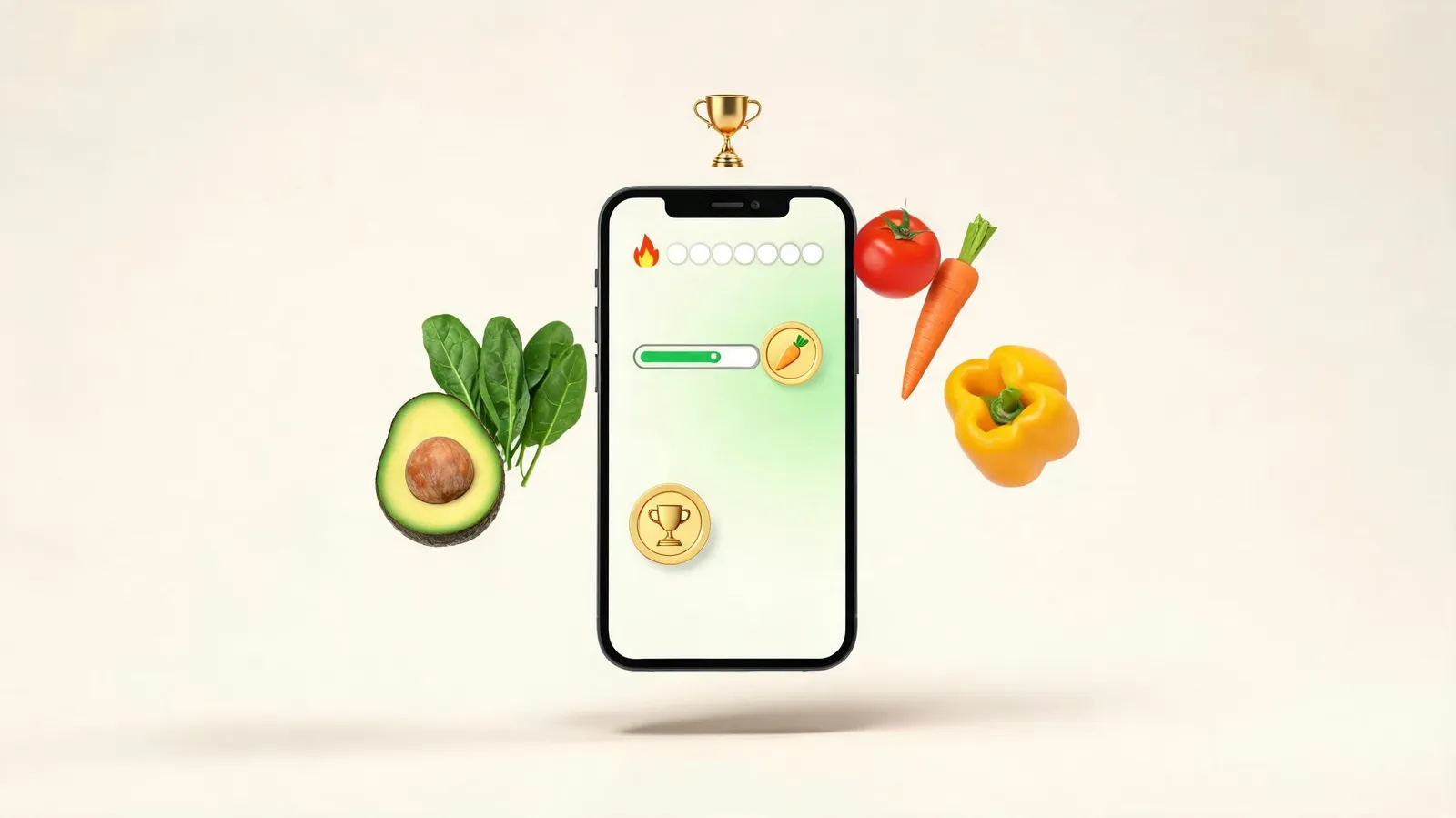
Gamification borrows elements such as points, badges, streaks, and leaderboards from game design and applies them to non-game settings to boost motivation. In healthy cooking, it tackles a familiar obstacle: making meal preparation feel less like drudgery and more like an engaging challenge. A 2023 study in the Journal of Nutrition Education and Behavior reported that gamified cooking apps raised the frequency of home cooking by 35% per week among participants. Examples like Plant Nanny, which gamifies water intake through virtual plant growth, and Habitica, which recasts daily tasks as a role-playing game, show how game mechanics can influence behavior. For cooking specifically, apps that reward trying new vegetables with badges, maintain streaks for consecutive days of home cooking, and let users compete with friends on leaderboards can create a strong engagement loop.
Still, gamification needs careful design to avoid eroding intrinsic motivation. Leaning too heavily on extrinsic rewards—points, badges, virtual currency—can lead users to disengage once those rewards cease. The challenge is to design strategies that gradually move users from external incentives toward internal satisfaction. This can be done by shifting emphasis from points to personal progress tracking, from leaderboards to self-referential goals, and from badges to meaningful reflections on health improvements. UX designers should build in mechanisms that support autonomy, competence, and relatedness—the three psychological needs highlighted by self-determination theory—to encourage lasting habits. When gamification aligns with intrinsic goals, it becomes a powerful way to make healthy cooking a sustainable habit rather than a short-lived challenge.
3. Accessibility Design for Older Adults and People with Disabilities: Inclusive Behavior Change
Digital health tools frequently overlook the needs of elderly and disabled users, creating barriers that shut millions out of behavior change technology. Research shows that limited digital literacy and motor impairments are more common among older adults, and typical accessibility obstacles include small text, complex navigation, and missing screen reader support. For instance, a 2024 AARP report found that 61% of adults over 65 have trouble with basic navigation in health apps, and 45% say they struggle to read text without zooming. These are not minor annoyances—they actively prevent a substantial segment of the population from participating in digital health interventions that could enhance their quality of life.
Universal design principles point toward a solution. The Web Content Accessibility Guidelines (WCAG) offer a framework for making digital content perceivable, operable, understandable, and robust. Applying these guidelines to health apps means using large, high-contrast text; simple, linear navigation; voice commands and screen reader compatibility; and customizable interfaces that adapt to individual needs. A case study of an accessible dietary coaching app for seniors showed a 50% increase in engagement among users over 70. The app included voice-guided meal planning, tactile buttons, and a simplified interface with minimal steps. For UX designers, accessibility is not an afterthought—it is a core requirement that broadens the reach and impact of behavior change tools. Inclusive design helps ensure that elderly and disabled users can fully participate in digital health interventions, leading to more equitable health outcomes.
Conclusion: A Unified Approach to Behavior Change
Bringing together conversational AI, gamification, and accessibility design offers a holistic approach to UX-driven behavior change in digital health. Conversational AI delivers personalized, empathetic coaching that builds trust and accountability. Gamification makes healthy cooking an engaging challenge, drawing on both extrinsic and intrinsic motivation to form durable habits. Accessibility design ensures these tools are available to all users, regardless of age or ability. Together, these three directions respond to the engagement crisis by creating experiences that are personalized, motivating, and inclusive. The future of digital health lies in AI’s ability to adapt gamification and accessibility features in real time based on user behavior and needs. By embracing this holistic approach, health tech product managers, UX designers, and behavioral scientists can create solutions that not only attract users but also sustain their engagement and drive meaningful, long-term behavior change.