
Introduction
Picture materials that repair their own damage, structures designed to steer waves, and production methods that span from the nanoscale up to full-scale components. Conventional materials and fabrication routes run into obstacles when it comes to performance, sustainability, and scalability. Advanced materials — among them 2D materials, metamaterials, and self-healing or smart materials — paired with additive manufacturing that can scale up, are opening capabilities that were previously out of reach across a range of industries.
Engineering at the Atomic Scale: 2D Materials and Metamaterials
Materials such as graphene and MXenes, which are just a few atoms thick, show remarkable electrical, thermal, and mechanical behavior. Graphene's strength (200 times that of steel) and its conductivity suit it to flexible electronics and composites, while MXenes stand out for electromagnetic interference shielding. Metamaterials get their properties from their structure instead of their composition, which makes phenomena like negative refraction and acoustic cloaking possible. Examples include metamaterials used to miniaturize antennas and the potential to manipulate seismic waves.
These materials are already shifting from laboratory work toward fabrication. Graphene-enhanced composites, for instance, are being tested in aerospace applications aimed at weight reduction, and metamaterial antennas are helping shrink 5G hardware. Achieving scalable production with consistent quality remains the central challenge.
Additive Manufacturing at Scale: Moving from Prototypes to Production
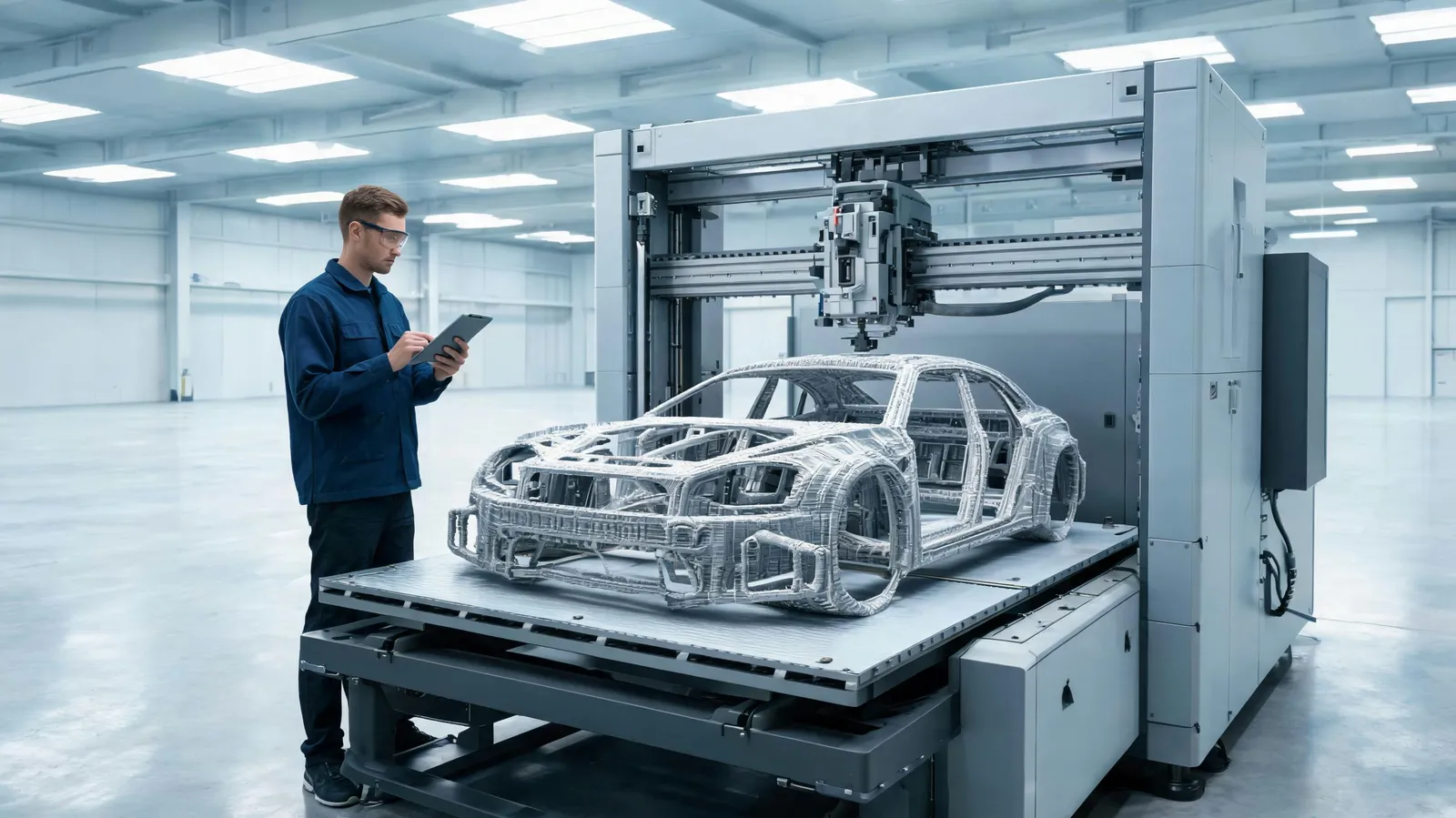
Large-scale additive manufacturing (LSAM) makes it possible to produce large parts quickly while generating less waste. Aerospace and automotive examples include the Strati car and rocket engines, built with material extrusion and directed energy deposition techniques. Scaling up brings difficulties involving material properties, speed, and post-processing. Continuing research into high-performance polymers and metals, along with hybrid manufacturing that combines additive and subtractive processes, is being directed at these issues.
LSAM systems now print parts measuring more than 10 feet, with deposition rates above 100 pounds per hour. Companies such as Relativity Space and Stratasys are extending the boundaries, yet certification and standardization continue to be obstacles.
Responsive Systems Emerge: Self-Healing and Smart Materials
Self-healing materials are able to repair damage on their own, which extends service life and improves safety. Examples span self-healing concrete, polymers, and coatings, and the mechanisms involved include microcapsules, vascular networks, and reversible bonds. Smart materials alter their properties when exposed to stimuli such as temperature, stress, or magnetic fields. Shape memory alloys and piezoelectric materials find use in soft robotics and adaptive structures.
Recent advances include self-healing hydrogels for wound dressings and shape memory polymers for deployable space structures. The market for self-healing materials is projected to reach $4.5 billion by 2027, with infrastructure and healthcare as the driving sectors.
Bringing Advanced Materials Together with Scalable Manufacturing
Additive manufacturing makes complex geometries feasible when advanced materials are used. Emerging directions include 3D printing of metamaterials and 2D material composites, as well as multi-material printing for self-healing structures. Among the challenges and future directions are standardization, cost, and the circular economy. Industry standards for material characterization are needed, and sustainable manufacturing with recyclable materials holds significant potential.
Multi-material extrusion, for example, can pair a self-healing polymer with a conductive graphene layer to produce structures that sense damage. Even so, adoption is slowed by the absence of standards for testing and certification.
Conclusion
Advanced materials and manufacturing are coming together to enable new capabilities. 2D materials, metamaterials, additive manufacturing, and self-healing or smart materials are set to drive innovation in aerospace, healthcare, energy, and consumer products. The outlook includes integration with AI and digital twins for intelligent manufacturing, along with the emergence of sustainable, circular material ecosystems. Stakeholders should invest in R&D, standards, and workforce development to take advantage of this shift.