Sector Spotlight: The Productivity Payoff of Automation, Digitalization, and Resilience
Productivity growth worldwide has been decelerating for more than ten years, but certain industries are countering this trend through focused innovation. Productivity is not a uniform measure—it differs markedly across manufacturing, healthcare, retail/logistics, and the public sector. This analysis explores how automation, digitalization, and resilience strategies are producing concrete efficiency gains in each of these four areas, drawing out shared patterns and practical lessons for boosting output.
1. Manufacturing: Automation, Robotics, and Supply-Chain Resilience
For years, manufacturing has served as a key indicator of productivity trends, and the sector is currently experiencing a deep transformation. Advanced automation, robotics, and a renewed emphasis on supply-chain resilience are producing efficiency improvements that would have seemed far-fetched a decade ago.
1.1 Robotics and Cobots: Reshaping Assembly Lines
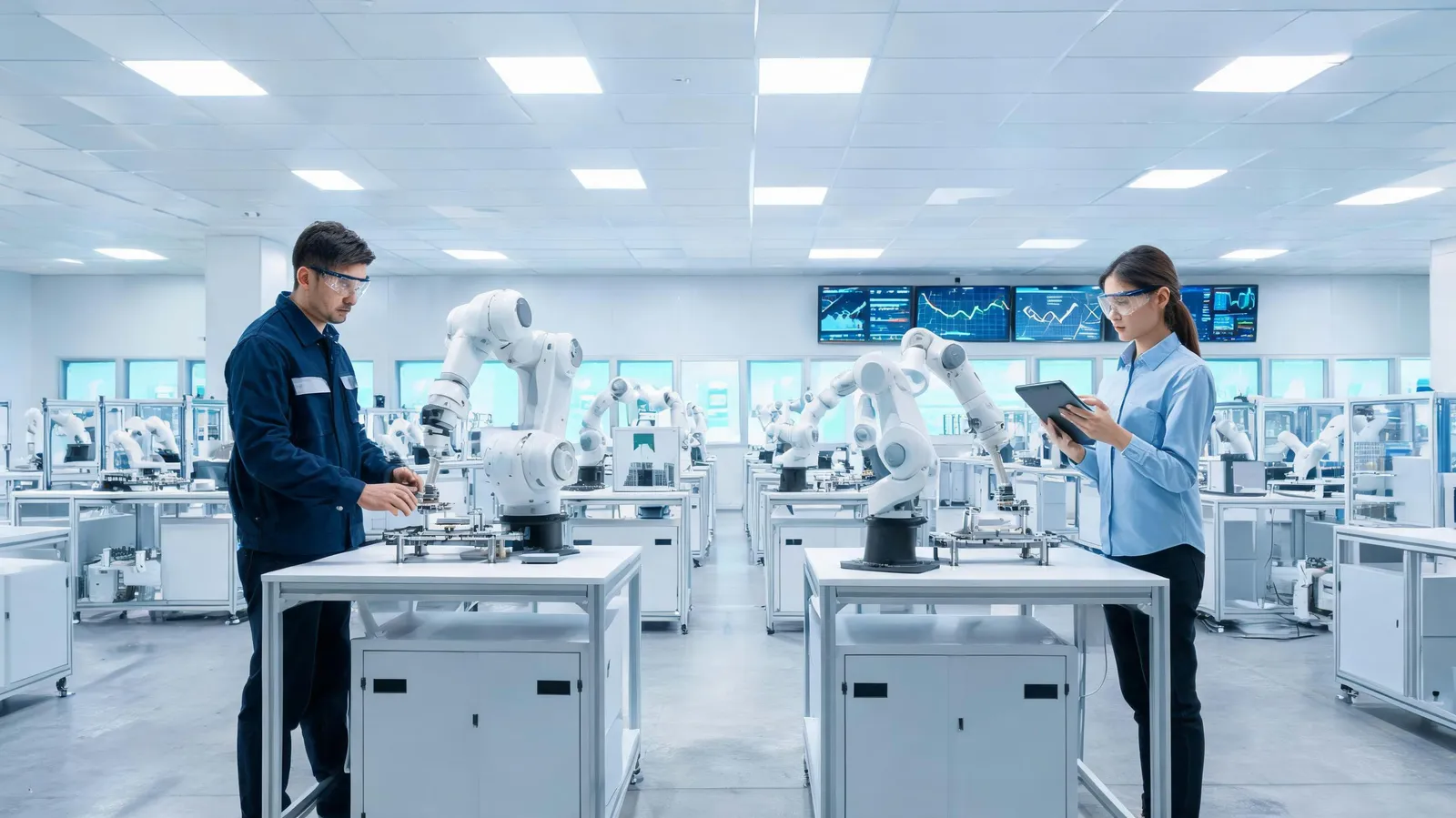
Collaborative robots, or cobots, have moved beyond the experimental stage. They are increasingly working alongside human employees on assembly lines, taking on repetitive, hazardous, or precision-heavy tasks. This partnership cuts downtime, raises quality, and frees human workers to concentrate on higher-value activities such as process improvement and quality control.
The International Federation of Robotics reports that robot installations in the United States rose by 12% in 2023, with the automotive and electronics industries driving the increase. Output per worker in highly automated plants can be 30-40% higher than in traditional facilities. One notable example is a Midwest automotive parts manufacturer that brought production back from overseas after deploying a fleet of cobots. The company cut lead times by 40% and reduced labor costs by 25%, while also improving workplace safety.
1.2 Supply-Chain Resilience as a Productivity Priority
The pandemic's supply-chain disruptions revealed the vulnerability of globalized, just-in-time manufacturing. Today, resilience is not merely a risk-management issue; it is a productivity priority. Companies are investing in digital twins, predictive maintenance, and nearshoring strategies to reduce downtime and respond more quickly to market shifts.
Predictive maintenance, driven by IoT sensors and AI, can cut unplanned downtime by up to 50% and extend machine life by 20-40%. Digital twins—virtual replicas of physical assets—enable manufacturers to simulate and optimize production processes without disrupting actual operations. For instance, a large appliance manufacturer used a digital twin to redesign its assembly line, achieving a 15% increase in throughput.
Nearshoring and flexible manufacturing strategies are also gaining momentum. By moving production closer to end markets, companies reduce lead times, lower transportation costs, and become more responsive to customer demands. A survey by Deloitte found that 62% of US manufacturers are likely to nearshore some operations in the next three years.
2. Healthcare Productivity: Administrative Burden versus Care Delivery
Healthcare presents a productivity paradox: while medical technology has advanced rapidly, administrative overhead often consumes a significant portion of clinician time, undermining overall productivity. The challenge is to reduce administrative burden while enhancing care delivery through thoughtful digitalization.

2.1 The Administrative Burden on Clinicians
Studies show that physicians spend nearly two hours on administrative work for every hour of direct patient care. This includes documentation, billing, scheduling, and prior authorizations. The result is less time for patients, higher burnout rates, and reduced productivity.
AI-powered scheduling and billing systems are beginning to alleviate this burden. For instance, a large hospital network implemented an AI-driven scheduling tool that reduced no-shows by 18% and increased appointment utilization by 12%. Similarly, automated billing systems can cut claim denials by up to 30%, accelerating revenue cycles.
2.2 Digital Health Tools and Telehealth
Telehealth and remote monitoring can enhance care delivery productivity when integrated thoughtfully. During the pandemic, telehealth adoption skyrocketed, and many patients and providers have continued to use it. Data shows that telehealth visits can increase patient throughput by 20-30% for certain specialties, while maintaining high satisfaction rates.
A case in point: a rural hospital reduced readmissions by 25% using remote patient monitoring for chronic conditions. By equipping patients with connected devices and providing regular virtual check-ins, the hospital improved outcomes and freed up beds for acute cases. The key is to integrate these tools into existing workflows rather than adding them as standalone solutions.
3. Retail and Logistics: E-commerce, Warehouse Automation, and Last-Mile Efficiency
The explosive growth of e-commerce has put immense pressure on retail and logistics operations. To meet customer expectations for fast, accurate delivery, companies are turning to warehouse automation and innovative last-mile solutions.
3.1 Warehouse Automation: Meeting E-commerce Demand
Automated storage and retrieval systems (AS/RS) and autonomous mobile robots (AMRs) are critical to modern fulfillment centers. These technologies enable faster order fulfillment, higher accuracy, and better use of space. For example, a major US retailer deployed thousands of AMRs across its warehouses, achieving a 30% increase in picking efficiency and a 20% reduction in labor costs.
Data from the Material Handling Institute shows that warehouses with high levels of automation can process orders 2-3 times faster than manual operations, with error rates below 0.1%. As e-commerce continues to grow, automation will become table stakes for competitive retailers.
3.2 Last-Mile Efficiency: The New Frontier
Last-mile delivery is the most expensive and time-consuming part of the supply chain. Companies are experimenting with drones, lockers, and route optimization algorithms to reduce costs and improve speed. Pilot programs for autonomous delivery vehicles have shown promising results, with some reporting a 15-20% reduction in delivery costs per package.
Customer expectations are also evolving. A survey by McKinsey found that 60% of consumers are willing to pay extra for same-day delivery, and 40% expect delivery within two hours for certain items. To meet these demands, retailers are investing in micro-fulfillment centers closer to urban areas, enabling faster delivery and lower transportation costs.
4. Public-Sector Productivity: Digital Services, Procurement, and Accountability
The public sector faces unique productivity challenges, including bureaucratic processes, legacy systems, and political constraints. However, digital transformation and procurement reforms can significantly boost productivity while maintaining accountability.
4.1 Digital Government Services
E-government platforms are streamlining interactions between citizens and government agencies, reducing processing times and improving satisfaction. For example, the state of California implemented a digital portal for business permits, cutting approval times from weeks to days. Similarly, the IRS's online filing system has reduced processing costs by millions of dollars annually.
Metrics on adoption rates and time savings are compelling. A study by the Boston Consulting Group found that digital government services can reduce transaction costs by 50-70% and improve citizen satisfaction by 20-30%. The key is to design services around user needs and ensure accessibility for all citizens.
4.2 Modern Procurement and Accountability
Procurement reforms, such as agile contracting and outcome-based contracts, can accelerate IT projects and reduce cost overruns. Traditional procurement often leads to lengthy timelines and rigid requirements, resulting in failed projects. Agile procurement, on the other hand, emphasizes collaboration, iterative development, and flexibility.
For instance, the US Digital Service helped the Department of Veterans Affairs modernize its benefits system using agile methods, delivering a working prototype in six months instead of the typical two-year cycle. Transparency and accountability frameworks are also essential to ensure that productivity gains are sustainable and equitable.
Conclusion: Common Drivers of Productivity Growth
Across manufacturing, healthcare, retail/logistics, and the public sector, common drivers of productivity growth are evident: automation, digitalization, and resilience. While the specific technologies and strategies differ, the underlying principles are the same—leverage data and technology to do more with less, while building flexibility to withstand shocks.
Productivity gains are achievable, but they require tailored approaches and sustained investment in both technology and people. As AI, IoT, and advanced analytics continue to mature, their potential to transform productivity across all sectors will only grow. Leaders who embrace change and foster a culture of continuous improvement will be best positioned to thrive in the decades ahead.