Introduction
Health-conscious eating and on-demand food delivery have fueled demand for personalized meal recommendations. But generic suggestions often fall short of matching individual taste and nutritional requirements. Dietary preferences are inherently complex, involving flavor, health objectives, and shifting user behavior—making traditional recommendation systems ill-equipped. This article reviews core personalization algorithms—collaborative filtering, content-based filtering, and adaptive learning—and how they tackle issues such as cold-start users and the tension between taste and nutrition.
Collaborative Filtering vs. Content-Based Recommendation for Meal Suggestions
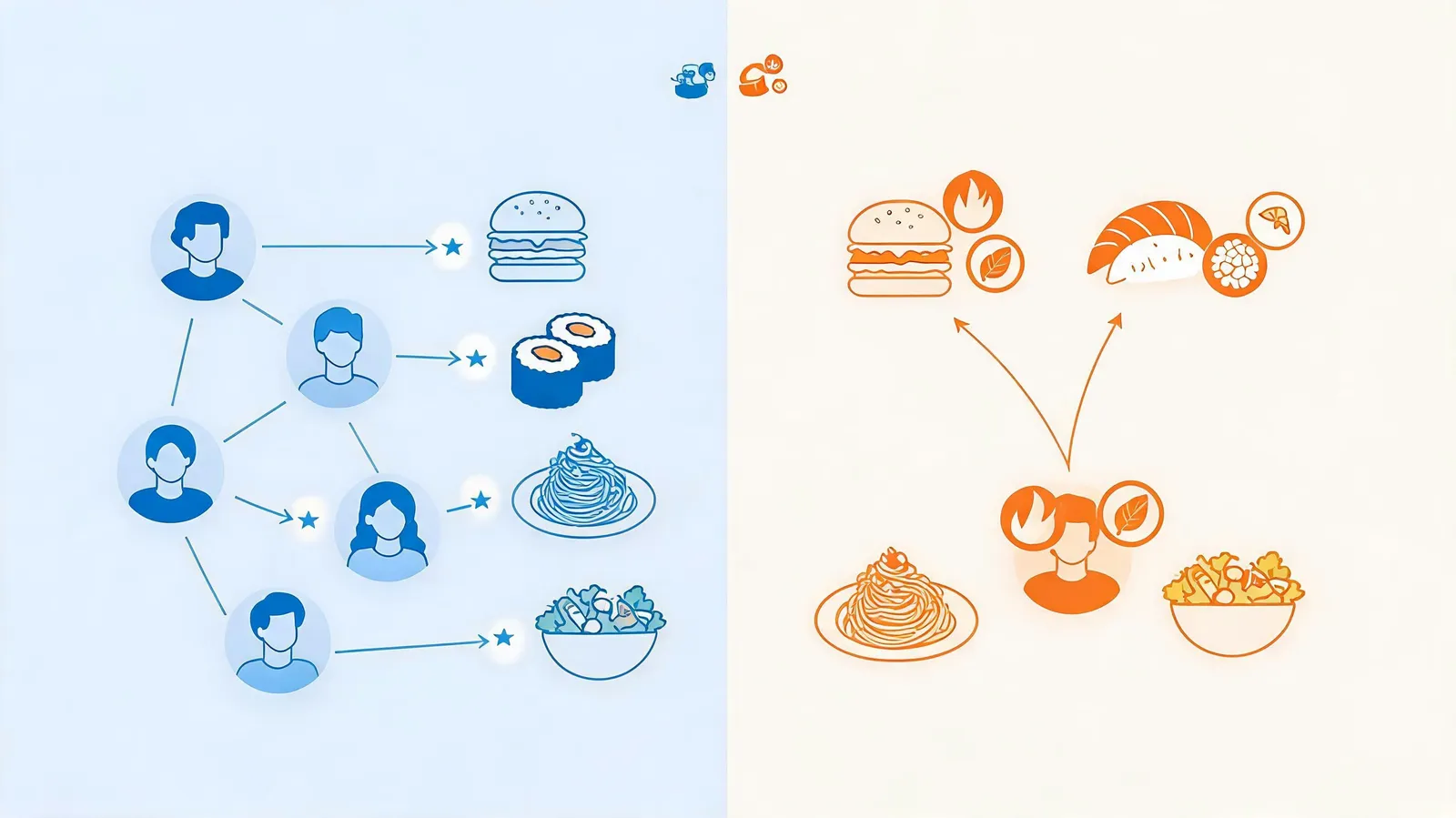
Collaborative filtering draws on similarities between users and their past ratings to propose meals that like-minded people enjoyed. For instance, if users who favored low-carb meals also rated certain recipes highly, the system would offer those recipes to other low-carb eaters. This method shines with large user bases because it can reveal non-obvious patterns. However, it falters when user-item interactions are sparse.
Content-based filtering, by contrast, relies on item attributes (ingredients, nutritional profile) and user preferences to recommend similar items. A user who enjoys spicy food would receive recommendations for other spicy dishes. This approach handles new items effectively and yields explainable recommendations, but it can overspecialize and overlook diverse options.
Hybrid approaches merge both methods to mitigate their limitations. A meal kit service, for example, might use collaborative filtering to generate initial candidates and then apply content-based filtering to refine them according to nutritional needs. Metrics indicate improved user satisfaction and retention when hybrid systems are deployed.
Handling Cold-Start Users with Limited Dietary History
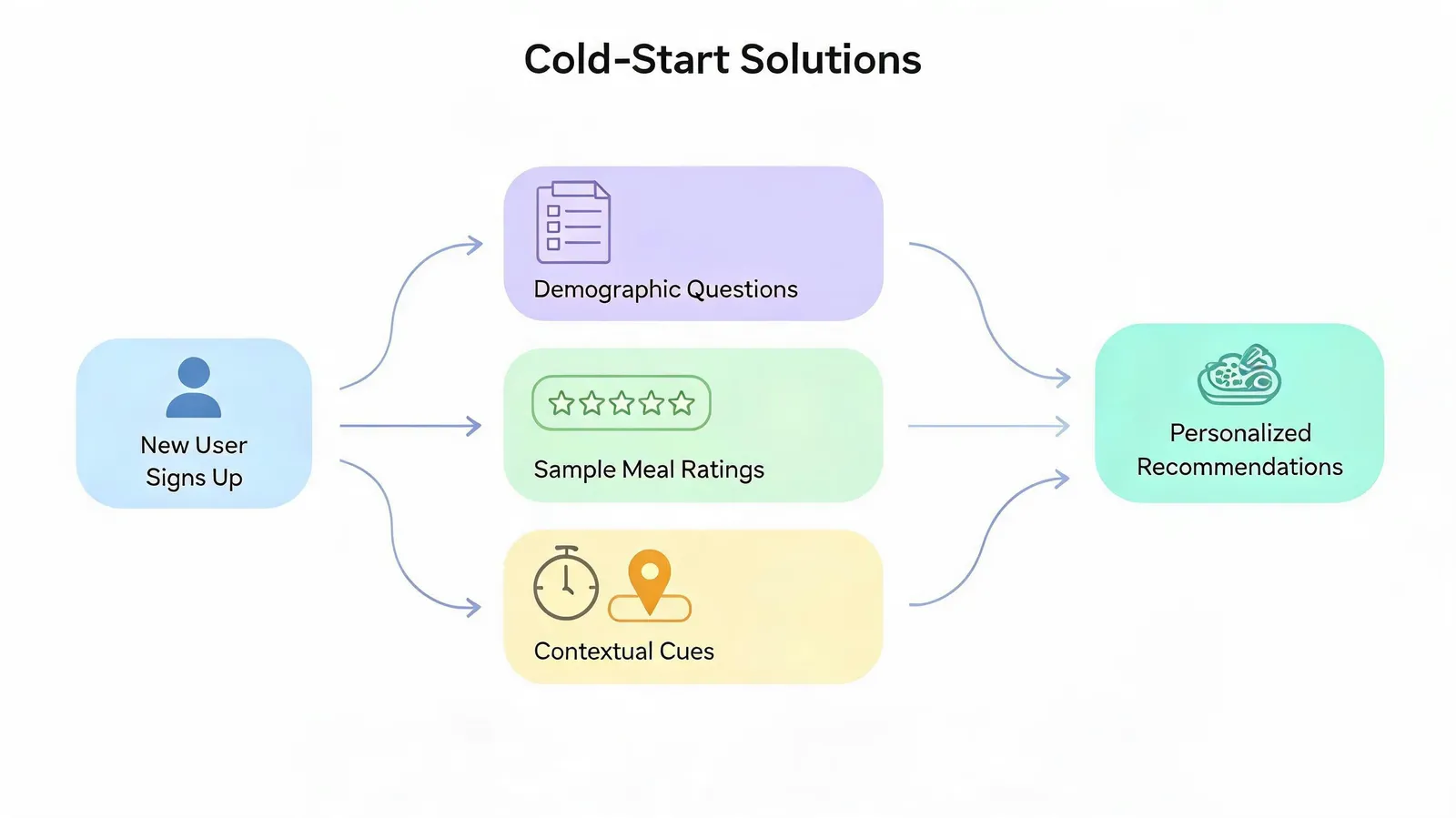
The cold-start problem arises when new users have no ratings or interaction history, complicating personalized recommendations. Statistics reveal that poor initial recommendations lead to high user drop-off and reduced engagement. To counter this, systems use demographic-based recommendations, onboarding questionnaires, and active learning. For example, asking users to rate a few sample meals during sign-up can quickly bootstrap their profile. A case study of a diet app reduced cold-start time by 50% using such techniques.
Leveraging contextual information (time of day, location) can further bootstrap preferences. Research on context-aware recommender systems shows that suggesting breakfast items in the morning or healthy snacks near a gym increases relevance. By combining these strategies, systems can deliver personalized recommendations even without historical data.
Adaptive Learning from User Ratings, Swaps, and Skipped Meals
Adaptive learning allows systems to continuously improve from user interactions. Implicit feedback—such as swaps and skipped meals—provides signals about preferences and dislikes. For example, skipping a recommended meal indicates dislike or lack of interest. Data shows that incorporating implicit feedback improves model accuracy over time.
Explicit feedback—ratings and likes/dislikes—are direct indicators. A comparison of explicit vs. implicit feedback reveals that while explicit feedback is more precise, implicit feedback is more abundant. A meal planner that increased retention by 30% used adaptive learning to adjust recommendations based on both types of feedback.
Reinforcement learning and online learning techniques, such as multi-armed bandits, allow real-time adaptation. For instance, dynamically adjusting recommendations based on recent behavior ensures that the system stays aligned with changing user preferences.
Balancing Taste Preferences with Nutritional Targets
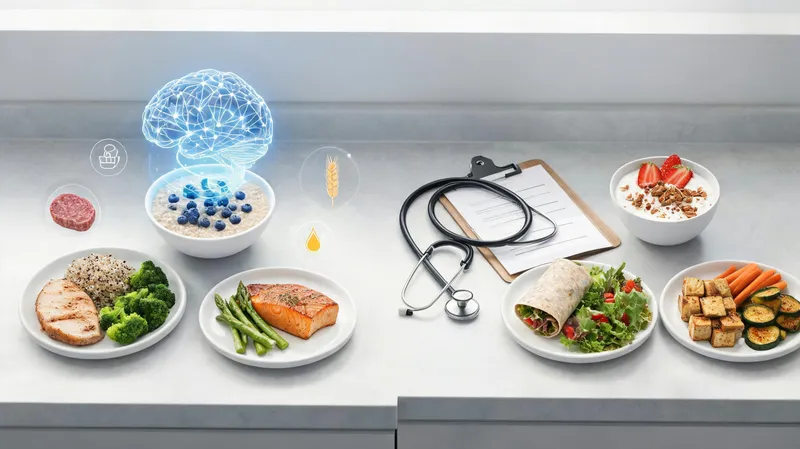
Balancing taste and nutrition is a multi-objective optimization problem. Recommending a meal that is both delicious and meets macro targets requires techniques like constraint-based recommendation, Pareto optimization, and weighted scoring. A fitness app that improved adherence to diet plans used a weighted scoring system that prioritized taste for users with a history of abandoning strict diets.
Personalization of nutritional targets based on user health data and goals is crucial. For example, adjusting recommendations for diabetic users to limit sugar while maintaining flavor. Research on personalized nutrition shows that tailoring targets to individual health metrics increases long-term adherence.
Conclusion
Personalization algorithms—collaborative filtering, content-based filtering, cold-start solutions, adaptive learning, and taste-nutrition balancing—are transforming how we discover meals that fit our tastes and health goals. These algorithms enable personalized nutrition and improve user adherence to healthy eating. Future directions include integrating multimodal data (e.g., wearables, genetic info) and explainable AI for trust and transparency. As AI continues to evolve, the dream of truly personalized meals becomes a reality.