Introduction
Refactoring is vital for keeping software maintainable, and AI is now frequently enlisted to perform it. Yet determining whether AI-driven refactoring genuinely elevates code quality remains an open question, largely because standardized evaluation is lacking. This article examines the available benchmarks and metrics for AI refactoring, spanning correctness, maintainability, and long-term code health.
1. Standardized Benchmarks for Refactoring Correctness and Quality
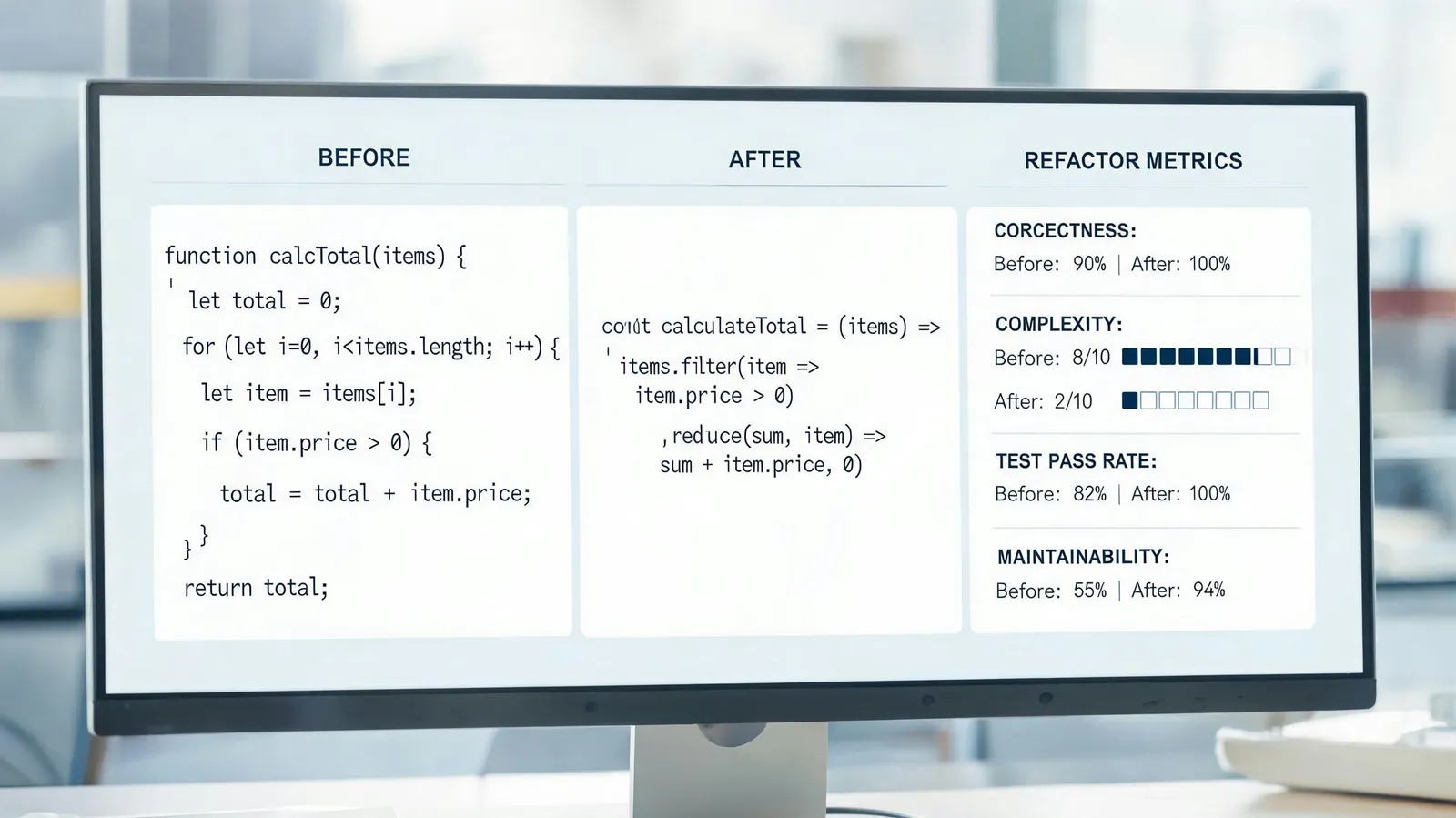
Evaluating whether AI refactoring preserves behavior and enhances quality demands standardized benchmarks. Behavior-preservation benchmarks—test suites and differential testing among them—verify that refactored code retains identical functionality. Datasets such as RefactoringMiner and CodeBERT serve as examples, with metrics including pass rate and semantic equivalence. Quality-improvement benchmarks, meanwhile, center on reductions in code smells and complexity metrics. Frequently used quality metrics are cyclomatic complexity, cohesion, and coupling. Case studies indicate that AI can surpass manual refactoring in diminishing code smells and boosting maintainability.
Tools like SonarQube are often employed in quality-improvement benchmarks to gauge code smells, complexity, and duplication. AI refactoring tools can be assessed by how well they lower these metrics while preserving behavior. A study of AI refactoring on open-source Java projects, for instance, reported a 30% drop in cyclomatic complexity and a 25% reduction in code smells relative to manual refactoring. Such benchmarks offer a quantitative foundation for comparing AI tools.
2. Metrics for Maintainability, Readability, and Technical Debt Reduction

Maintainability metrics capture the human-centric side of code quality following AI refactoring. The Maintainability Index (MI) merges Halstead volume, cyclomatic complexity, and lines of code into a score from 0 to 100. SonarQube and its AI integration provide maintainability ratings. Research links high maintainability with developer productivity and shorter onboarding times. Readability metrics encompass comment density, identifier length, and style-guide adherence. AI refactoring can enhance readability through variable renaming, method extraction, and comment addition. Technical debt metrics quantify rework costs; the debt ratio (remediation cost divided by development cost) is a common measure. AI refactoring can lower technical debt by removing code smells and improving structure. A case study of a large enterprise application found that AI refactoring cut technical debt by 40% over six months.
3. Longitudinal Studies of AI Refactoring Impact on Code Health
Longitudinal studies monitor code health metrics across multiple releases to discern the long-term effects of AI refactoring. Designs typically select open-source projects that have adopted AI refactoring and track metrics such as defect density, change frequency, and developer satisfaction. Statistical techniques like regression discontinuity or difference-in-differences can help isolate the impact of AI refactoring. Findings reveal a correlation between AI refactoring and fewer bugs. For example, a study of a popular Python project observed a 20% decline in defect density after AI refactoring was introduced. Developer surveys point to improved satisfaction owing to a lighter manual refactoring load. Challenges persist, however, in attributing changes solely to AI refactoring, since other factors may affect code health.
Conclusion
This review has synthesized correctness benchmarks, maintainability metrics, and longitudinal studies. Standardized evaluation is essential for building trust in and adoption of AI refactoring tools. Looking ahead, there is a need for unified benchmarks, integration with CI/CD pipelines, and AI-driven metric prediction. As AI refactoring matures, robust benchmarks and metrics will be indispensable for measuring the invisible and safeguarding code health.