Almost 70% of projects miss their deadlines — a systemic issue that drains billions of dollars from US businesses annually. Traditional project management leans on manual estimation, fixed schedules, and reactive problem-solving, which often leads to missed dates, exhausted teams, and stakeholders who lose confidence. Artificial intelligence, however, is steadily reshaping this flawed approach. AI-based deadline forecasting is changing how teams estimate timelines, assign resources, and monitor progress, shifting from guesswork to precision.
Predictive Timeline Estimation and Risk Notifications
Machine learning models now sift through historical project data to forecast realistic completion times with impressive accuracy. These systems go beyond simply checking how long a task took previously; they analyze thousands of factors such as team velocity, task complexity, dependency chains, seasonal trends, and individual performance histories. In software development, AI-assisted estimation has cut error rates by up to 40% relative to manual forecasting. When organizations replace intuition-based scheduling with predictive deadline estimation driven by machine learning, on-time delivery rates improve markedly.
Real-time risk alerts form the second key element of AI-powered deadline management. Rather than finding a bottleneck after it has already thrown the schedule off track, AI systems spot potential issues before they grow. When a resource becomes overloaded, a dependency slips, or completion rates stray from projections, alerts fire automatically. These early warnings let project managers act immediately — reassigning work, adjusting timelines, or adding support. Organizations that use proactive AI risk management report average cost savings of 15-25%, simply by addressing problems before they turn into crises.
Optimizing Resource Allocation Across Projects

Resource allocation optimization is one area where AI yields particularly tangible returns. Algorithms match team skills and availability to project tasks in real time, factoring in not only who is free but also who is best suited. This goes well beyond calendar checks: the system evaluates skill proficiency, past performance on similar tasks, current workload, and even predicted fatigue. Organizations adopting AI-driven resource allocation see utilization rates rise by 20-30% while reducing burnout through more balanced workload distribution.
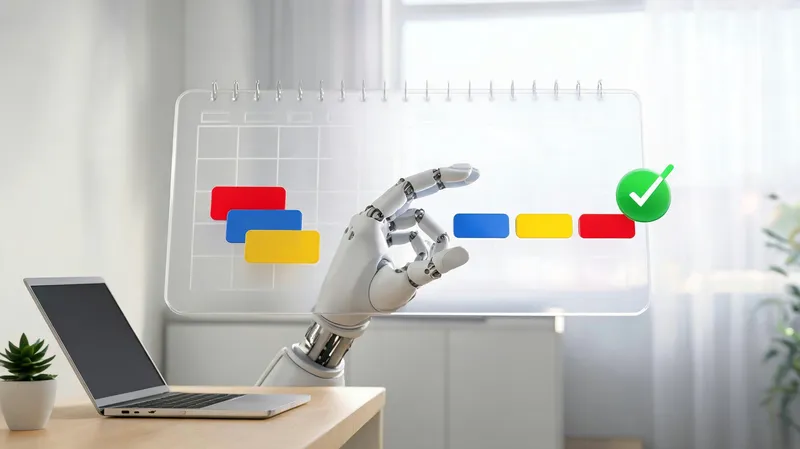
Dynamic reallocation is what sets AI apart from static planning tools. When priorities change, a team member falls ill, or an unexpected crisis demands attention, AI responds instantly. During a critical product launch, one US technology company suddenly lost two key engineers. Its AI project management system automatically redistributed tasks to available team members with matching skills, recalculated the timeline, and flagged only the two deliverables that truly needed schedule adjustments. The project shipped on time. Statistics consistently indicate that optimized resource use through AI lowers overall project costs by 10-20%.
Automated Progress Tracking and Reporting
Automated progress tracking removes one of the most tedious parts of project management: chasing updates. AI connects directly with tools such as Jira, Asana, Monday.com, and Trello to automatically track task completion, milestone achievements, and timeline adherence. Status meetings where people repeat what the system already knows become unnecessary, and manual Gantt chart updates are eliminated. Project managers reclaim 5-10 hours per week previously spent on reporting overhead.
Natural language processing further automates the process by generating concise, readable status reports and highlighting anomalies. Instead of poring over dashboards, stakeholders get clear summaries: “Development is 3 days ahead on the API integration but the testing phase shows a 15% slowdown due to environment issues.” AI-generated reports have been shown to boost stakeholder communication satisfaction by over 30% while enabling faster decisions. When anomalies occur — a task taking twice as long as predicted, or a team member's output dropping unexpectedly — the system flags them immediately with context and suggested actions.
Why Manual Project Management Falls Short
The case against manual project management is clear. Humans are poor at estimating timelines, hindered by planning fallacy, optimism bias, and a persistent inability to account for unknown unknowns. Static schedules become outdated within days. Reactive problem-solving means always fighting fires instead of preventing them. AI does not share these cognitive limitations: it processes data objectively, learns from every completed project, and never forgets a lesson. Organizations that still rely on spreadsheets and gut instinct are bringing a knife to a gunfight.
Toward Fully Autonomous Project Management
The direction is clear. AI project management deadline forecasting is moving toward fully autonomous systems. The next step involves integrating AI with blockchain for smart contracts that automatically trigger payments when milestones are verified. Imagine a construction project where AI monitors progress through IoT sensors, validates completion against contract terms via blockchain, and releases payment without human intervention. Or a marketing campaign where AI detects underperformance, reallocates budget in real time, and adjusts creative strategy based on engagement data — all without a project manager touching a single setting. This is not science fiction; every component exists today, and integration is already happening.
Conclusion
AI is not merely improving project management — it is fundamentally rewriting the rules. Predictive deadline estimation replaces guesswork with data-driven precision. Resource allocation optimization ensures every team member is deployed where they create maximum value. Automated progress tracking and AI-generated status reports free managers to focus on strategy instead of administration. AI risk alerts catch problems before they become disasters. Organizations that embrace AI project management deadline forecasting will consistently deliver on time, on budget, and with higher quality. Those that do not will keep missing deadlines and wondering why. The choice is stark, and the clock is ticking.