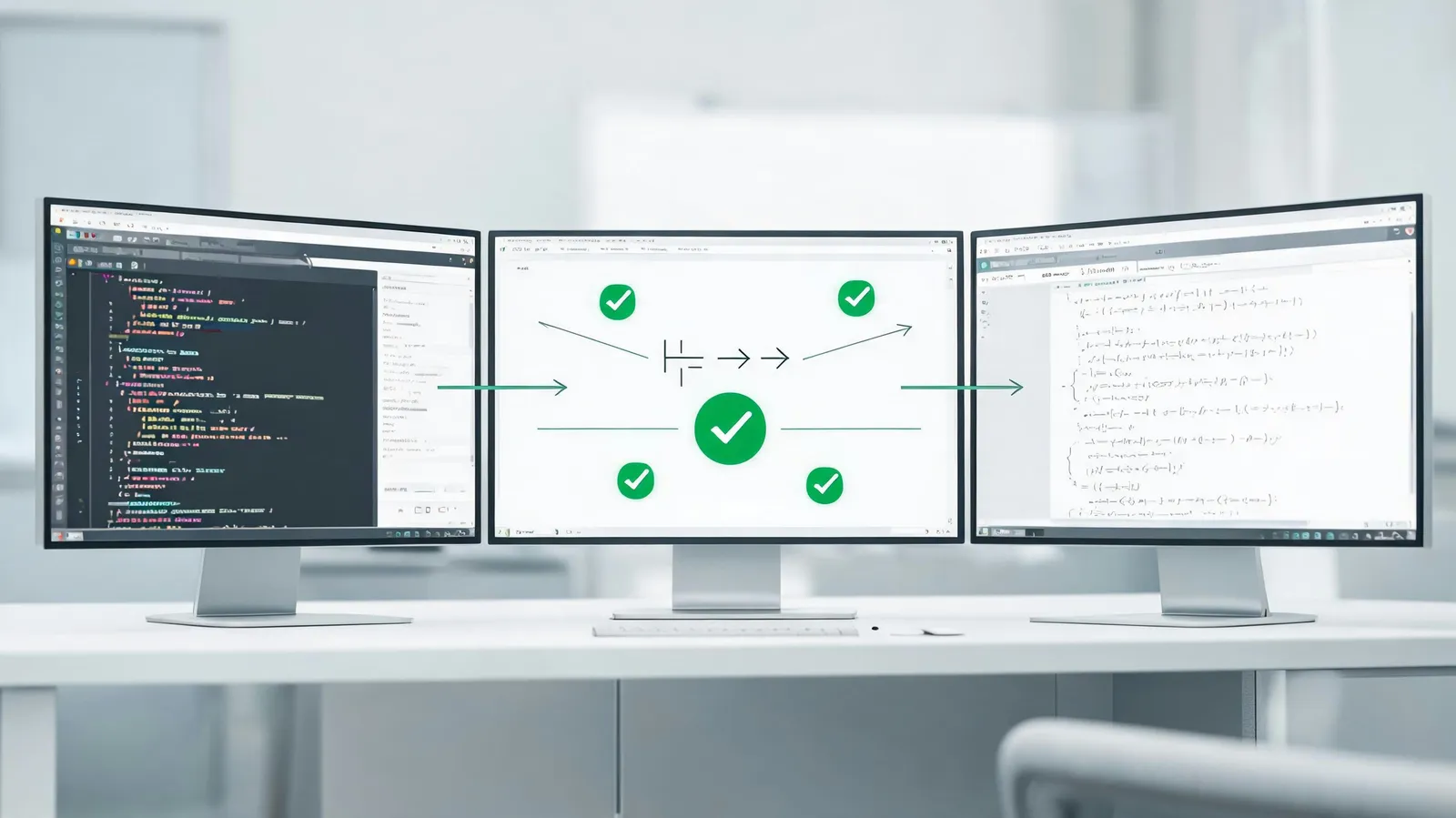
Machine-written code has moved well beyond demo status: it now sits inside production systems, internal utilities, and components where failure carries real safety consequences. With that shift comes an unavoidable question—how can anyone establish that such code behaves correctly, and what would justify placing trust in the systems producing it? No single method answers this. The plausible path forward is a combined approach resting on four supports: formal proof, quantified uncertainty, transparency of reasoning, and joint human-AI authorship.
Proving Generated Code Correct with Proof Assistants
Tests can demonstrate that bugs exist; they seldom demonstrate that none do. When the code comes from a model, that gap is particularly risky, since the model may embed subtle logical faults that ordinary test suites never exercise. Work examining defect rates in machine-generated code indicates that a non-trivial share of suggestions carry functional flaws, and a fair number of those flaws survive unit testing. A generated sorting routine, for instance, might handle small inputs yet break on edge cases such as duplicated values or empty arrays.
Mathematical verification supplies a firmer assurance. If proof assistants like Coq, Isabelle, or Lean are wired into the generation pipeline, teams can check mechanically that code meets a formal specification. One case study took a sorting algorithm produced by an LLM and rendered it in a proof assistant, where sortedness and permutation properties were checked against a formal spec; doing so surfaced a hidden defect in the model's original output. Scalability and automation are still open problems, but hybrid tactics are appearing: pairing lightweight formal methods with property-based testing and SMT solvers has cut critical bugs in safety-critical systems by notable margins.
Confidence Signals and Uncertainty Quantification in Code Models
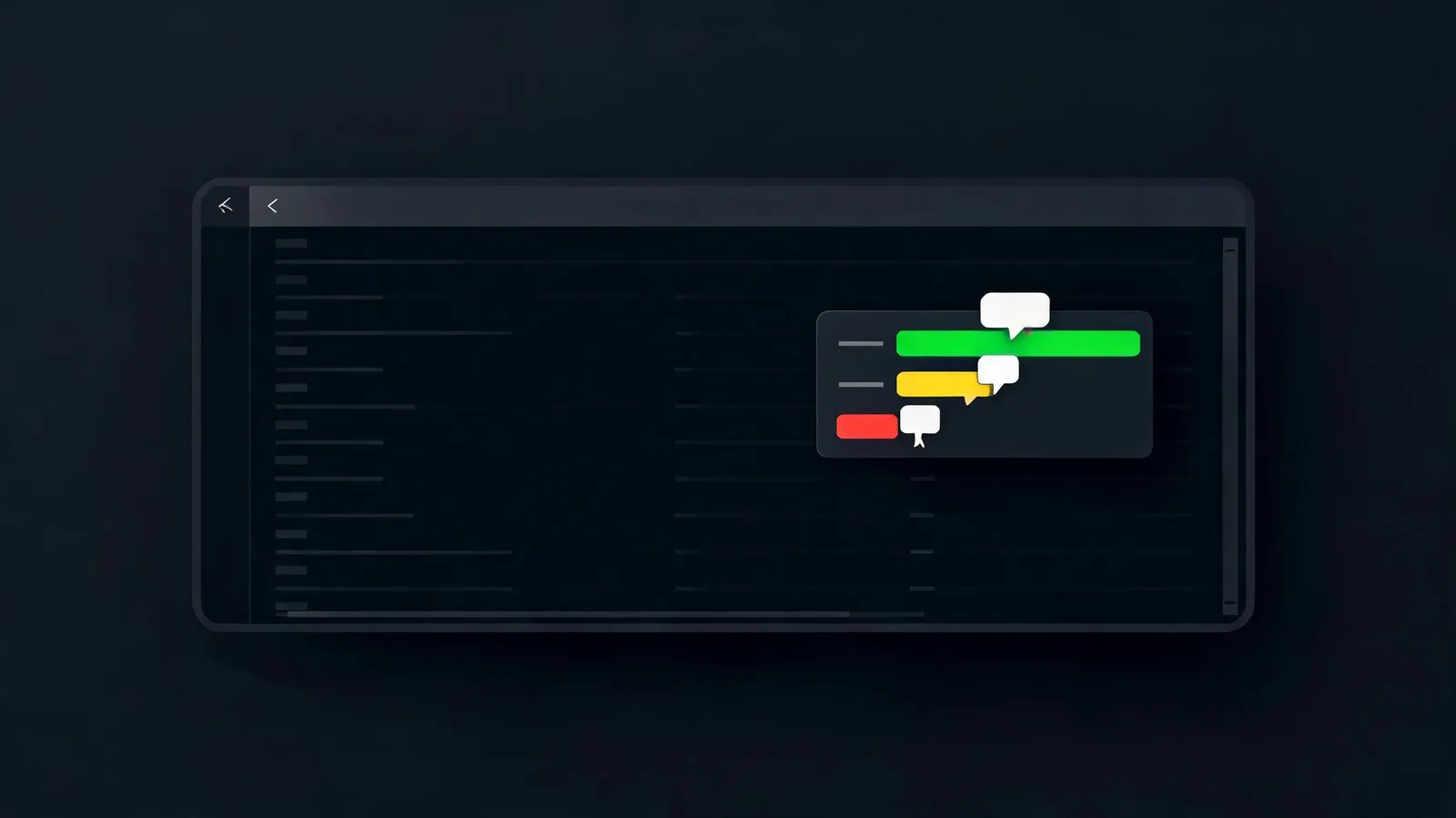
Code models tend to sound sure of themselves even when wrong. Invented APIs, faulty logic, and insecure patterns arrive in the same fluent register as correct suggestions. The result is quiet failure: developers take code that reads correctly but acts incorrectly. Studies with users indicate that repeated encounters with confident yet wrong suggestions wear down trust and slow uptake.
Quantifying uncertainty is meant to counter this. Bayesian methods, ensembles, and calibration can yield confidence scores that track how likely a suggestion is to be right. On code-generation benchmarks, calibrated models give more dependable signals than raw probability outputs. One case study reported that displaying confidence scores next to suggestions shortened debugging time and helped developers judge when to accept, edit, or discard model output.
How those signals are surfaced matters just as much. Human-computer interaction work indicates confidence should be noticeable without being distracting. An editor plugin that marks low-confidence suggestions with restrained color cues and tooltips can steer review toward the places that need it.
Making AI-Written Implementations Explainable and Debuggable
Generated code frequently arrives as an opaque artifact. Developers get the output without the reasoning behind it, which complicates debugging and leaves trust on shaky ground. Survey findings point to broad frustration with suggestions that offer no visible rationale, particularly when the generated code is intricate.
Explainable AI methods offer some relief. Attention visualizations can indicate which portions of the prompt shaped a suggestion. Counterfactual examples can show how altering a variable or condition would change the result. Plain-language rationales can state the logic the model intended. In one case study, counterfactuals helped a developer spot a bug in generated code by demonstrating that a different input would have yielded a null return.
Folding these capabilities into IDEs and debugging workflows is the logical next move. A prototype plugin that displayed step-by-step reasoning for a generated function drew favorable responses from users, who described better debugging efficiency and more willingness to rely on suggestions for complex tasks.
Co-Creation Arrangements for Human-AI Software Teams
The fourth support reframes AI from instrument to teammate. Under co-creation arrangements, humans and AI share ownership of the development process. Pair-programming case studies with AI report productivity gains alongside difficulties in communication, turn-taking, and shared understanding.
Interaction protocols for co-creation therefore need deliberate design. Mixed-initiative interfaces let both sides propose changes, negotiate, and refine solutions. A workable pattern is that the AI proposes while the human disposes, with feedback loops through which the model learns from human corrections. Shared mental models—where both parties grasp the goal, constraints, and context—cut down on misunderstanding and improve results.
Organizational and ethical questions also come into play. Accountability and credit assignment grow more tangled when code is jointly produced. Conventions for transparent AI contributions to codebases can help teams record what was generated, what was altered, and who reviewed it, supporting both trust and responsible engineering.
Conclusion
Earning trust in machine-generated code is not a matter of picking a single technique. It requires weaving formal verification, uncertainty quantification, explainability, and co-creation arrangements into one framework for responsible AI-assisted coding. Formal verification supplies mathematical assurance. Uncertainty quantification hands developers the confidence signals they need to decide well. Explainability converts black boxes into partners one can follow. Co-creation arrangements reset how humans and AI divide the work.
These strands are not separate research silos; real-world impact depends on combining them. Progress in AI-assisted software development will come from interdisciplinary work joining formal methods researchers, machine learning engineers, HCI specialists, and software teams. As the techniques mature, they should migrate from research prototypes into everyday tooling, letting developers trust generated code not because it looks plausible, but because it has been verified, calibrated, explained, and co-created.