Preventing Secret Leakage in AI Coding Assistants
AI coding assistants like GitHub Copilot, Amazon CodeWhisperer, and Tabnine have become essential for developers, accelerating coding by suggesting entire lines or blocks of code. However, this convenience introduces a significant risk: the inadvertent exposure of sensitive information, particularly secrets such as API keys, passwords, and tokens.
Common leakage vectors include training data, model memorization, and insecure API calls. When AI models are trained on vast repositories of public code, they may memorize and later reproduce secrets that were accidentally committed. A study by GitGuardian found that over 10 million secrets were leaked on public GitHub in 2023 alone, a 67% increase from the previous year. Furthermore, if the AI assistant's API calls are not properly secured, secrets could be intercepted in transit.
Mitigation strategies are essential. First, implement secret scanning tools like TruffleHog or GitGuardian in your CI/CD pipeline to detect secrets before they are committed. Second, configure AI tools to filter out sensitive context; for example, GitHub Copilot offers a setting to block suggestions matching public code. Third, use context-aware filtering to prevent the AI from accessing files containing secrets. Finally, ensure that API calls to AI services are encrypted and authenticated.
Industry leaders recommend a defense-in-depth approach. For instance, Google's internal guidelines for AI code completion emphasize never sending secrets to the model and using local models for sensitive codebases. By combining these strategies, organizations can significantly reduce the risk of secret leakage.
Compliance and Auditability of AI-Generated Code
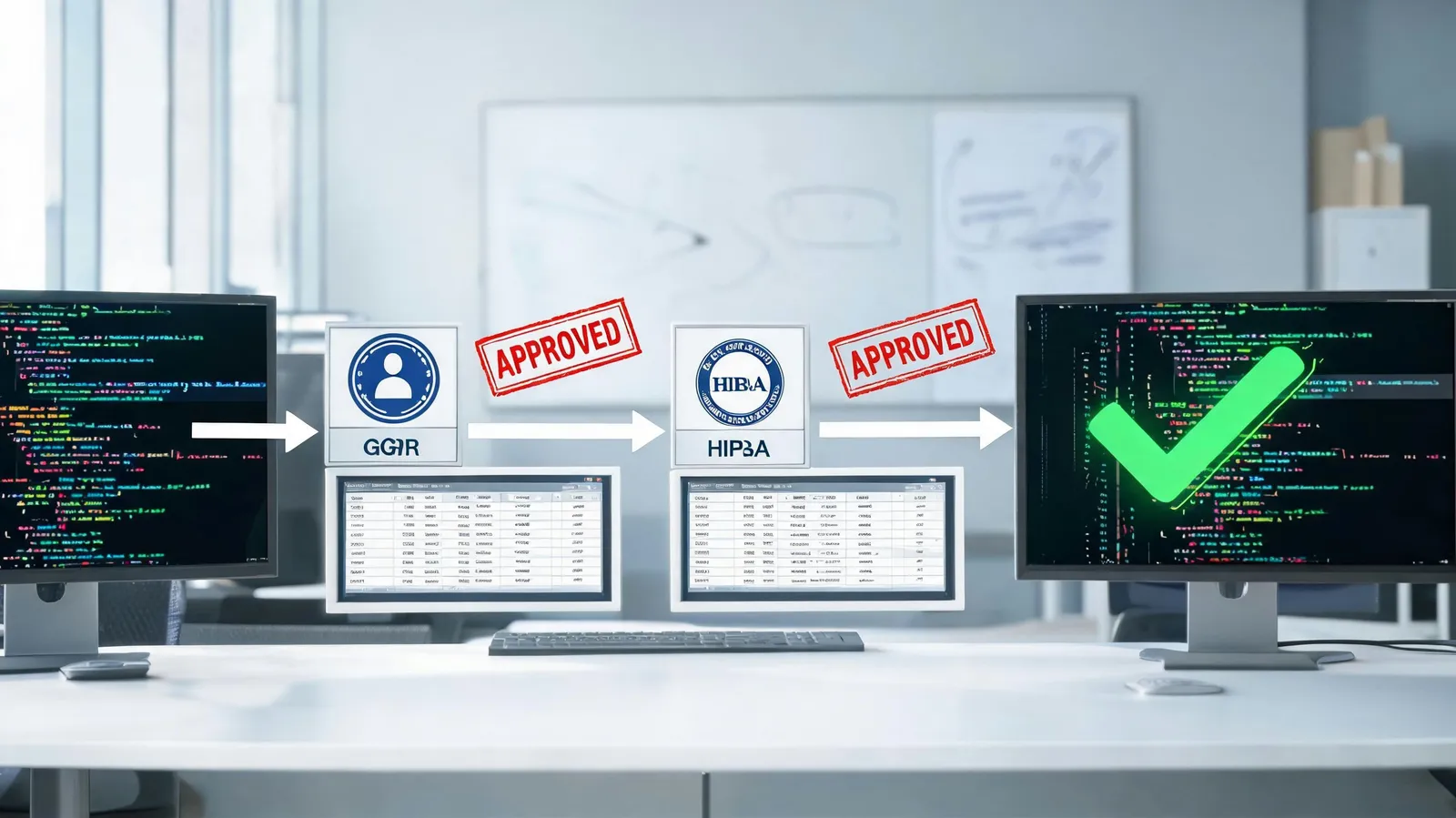
As AI-generated code becomes more prevalent, ensuring compliance with regulations such as GDPR, HIPAA, and industry-specific standards is paramount. These regulations mandate strict data protection and privacy measures, and AI-generated code must adhere to them.
The regulatory landscape is complex. GDPR requires that personal data be processed lawfully and transparently, while HIPAA sets strict rules for protected health information. AI-generated code that handles such data must comply. For example, if an AI assistant suggests code that processes personal data without proper consent mechanisms, it could lead to violations. Regulatory bodies like the FDA and FTC have issued guidelines emphasizing the need for auditability in AI systems.
Auditability is the ability to trace and verify the origins and modifications of code. For AI-generated code, this means tracking which parts were AI-generated, by which model, and under what conditions. Maintaining provenance is crucial for audits. Frameworks such as the AI Bill of Materials (AI BOM) and tools like Snyk and FOSSA can help track AI contributions. Case studies show that companies that implement robust audit trails, such as IBM with its AI Governance platform, can achieve compliance more efficiently.
To ensure compliance, organizations should integrate compliance checks into the development pipeline. Automated tools can scan AI-generated code for regulatory violations, and manual reviews should focus on high-risk areas. Additionally, maintaining detailed logs of AI interactions and code changes facilitates audits and demonstrates accountability.
Intellectual Property Risks in AI-Assisted Development
AI coding assistants are trained on vast amounts of code, much of which is copyrighted. This raises significant intellectual property (IP) concerns. When an AI suggests code that closely resembles existing copyrighted work, it could lead to infringement claims.
Ownership and licensing of AI-generated code are legally ambiguous. In the US, the Copyright Office has stated that works generated solely by AI without human authorship are not eligible for copyright protection. However, if a human modifies the AI output, the human may claim copyright. Different AI tools have varying licenses; for example, GitHub Copilot's training data includes public repositories, and its suggestions may be subject to the licenses of those repositories. Legal cases like Doe v. GitHub have challenged the legality of Copilot's training and output.
Risk mitigation involves several strategies. First, use IP scanning tools to detect potential matches with known copyrighted code. Tools like Black Duck and WhiteSource can identify license obligations. Second, implement license compliance checks to ensure that AI-generated code complies with open-source licenses. Third, consider indemnification from AI vendors; some, like Microsoft, offer IP indemnity for Copilot, but with conditions. Finally, establish internal policies that require developers to review AI suggestions for potential IP issues.
Organizations should also educate developers about IP risks and encourage the use of permissive licenses. By combining these measures, companies can reduce the risk of IP infringement while leveraging AI's benefits.
Zero-Trust Governance Models for Enterprise AI Dev Tools
Zero-trust is a security model that assumes no implicit trust and continuously verifies every access request. Applying zero-trust principles to AI dev tools can significantly enhance security and governance.
Principles of zero-trust include never trust, always verify, and least privilege. In the context of AI dev workflows, this means that AI tools should not be granted broad access to code repositories or sensitive data. Instead, access should be granted on a need-to-know basis, with continuous authentication and authorization. Benefits over traditional security models include reduced attack surface and better protection against insider threats.
Implementing zero-trust involves identity management, micro-segmentation, and continuous monitoring. Identity management ensures that only authorized users and services can access AI tools. Micro-segmentation divides the network into small zones to prevent lateral movement. Continuous monitoring detects anomalies in AI tool behavior. Case studies, such as Google's BeyondCorp, demonstrate the effectiveness of zero-trust. Tools like Okta, Azure AD, and Zscaler support zero-trust governance for AI dev tools.
For enterprises, adopting zero-trust for AI dev tools requires a cultural shift and investment in technology. However, the benefits—enhanced security, compliance, and trust—are substantial. As AI becomes more integrated into development, zero-trust will be essential for safeguarding assets.
Conclusion
Securing AI dev workflows is not optional; it is a necessity for enterprises that wish to harness AI's potential while mitigating risks. This guide has explored four critical areas: preventing secret leakage, ensuring compliance and auditability, managing intellectual property risks, and implementing zero-trust governance.
Secret leakage can be prevented through secret scanning, context-aware filtering, and secure configurations. Compliance requires understanding regulations and maintaining audit trails. IP risks demand careful licensing and scanning. Zero-trust governance provides a robust framework for access control and monitoring.
The significance of these measures cannot be overstated. As AI becomes more pervasive, the trust of customers, partners, and regulators depends on how well organizations secure their AI dev workflows. Looking ahead, emerging technologies like blockchain could enhance auditability by providing immutable logs. AI governance will continue to evolve, and proactive organizations will lead the way.
By implementing the strategies outlined in this guide, enterprises can build a secure, compliant, and trustworthy AI development environment. The future of software development is AI-assisted, and it must be secured.