Introduction
Across code generation, testing, review, and deployment, AI has become a routine presence. Even so, many organizations still operate without a coherent way to assess what it costs and how it changes the way teams work. With AI developer tools being adopted at a faster clip, engineering leaders are confronting uncertain returns, evolving job responsibilities, platform decisions that trade off building against buying, and the risk of becoming dependent on a single vendor. Sustainable value from these workflows depends on treating them as an economic and organizational system at once: measuring returns, reshaping team structures, making deliberate make-or-buy choices, and keeping the toolchain interoperable.
1. Return-on-Investment Models for AI Developer Tooling in the Enterprise
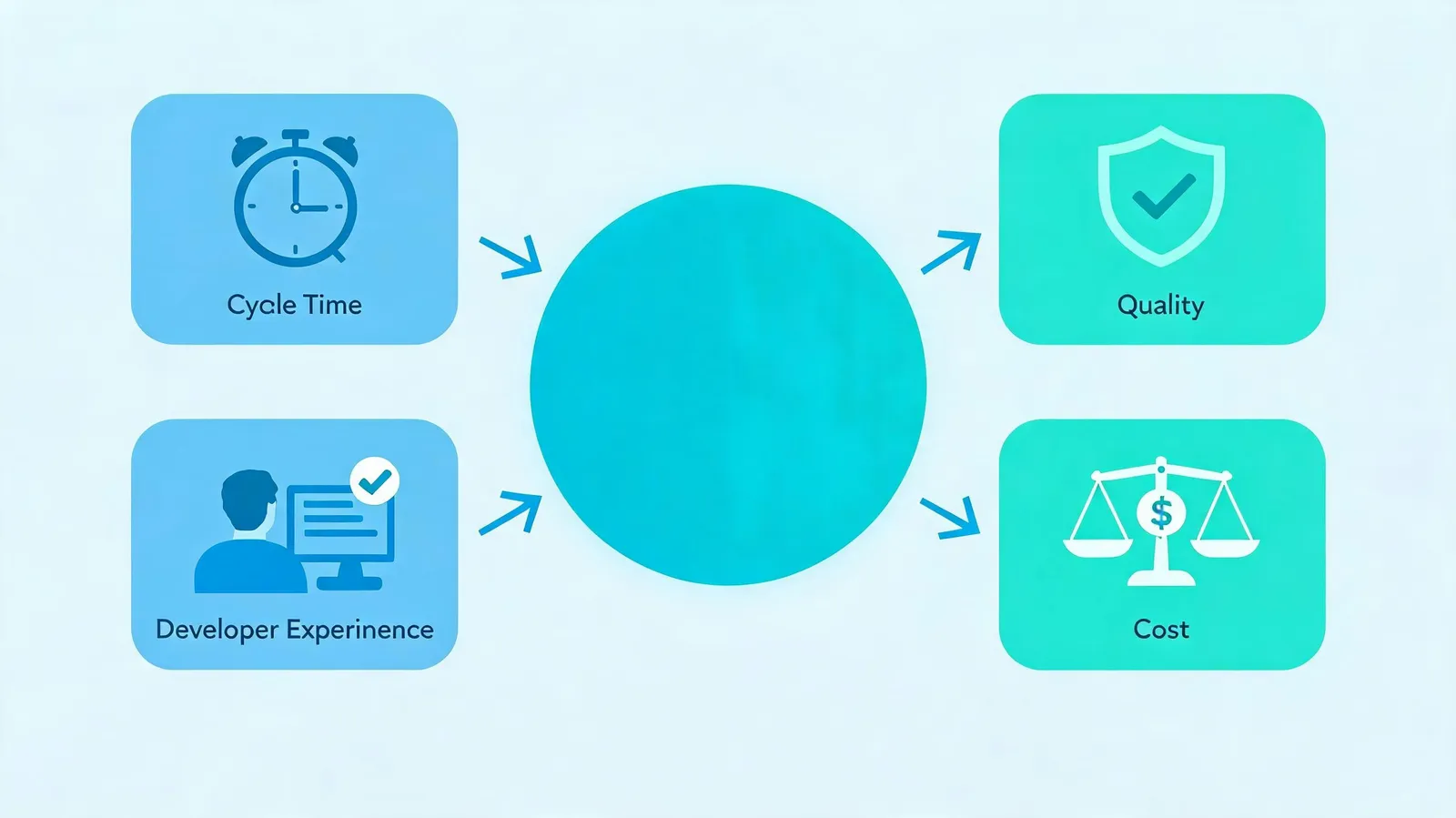
Simple productivity claims are not enough when calculating return on investment (ROI) for AI developer tooling. A framework with multiple dimensions weighs cycle time, quality, developer experience, and cost. Among the key measures are lead time to change, change failure rate, and review latency. One ROI model, for instance, might set tooling costs against reductions in rework and faster onboarding. Attribution remains difficult, however: separating the effect of AI from process changes and hiring shifts calls for control groups and staged rollouts. Adoption rate serves as a leading indicator, while defect density is a lagging one that helps track progress.
Licensing, inference, integration, and enablement make up the cost structure. Subscriptions and compute are direct costs; training and workflow adjustments are indirect. Scenario analysis comparing small and large engineering organizations shows that smaller teams may do better with off-the-shelf tools, while larger enterprises may be able to justify custom platforms. Establishing baseline metrics before AI adoption and monitoring them continuously is essential for accurate ROI measurement.
2. How Team Structure Shifts in AI-Augmented Engineering Organizations
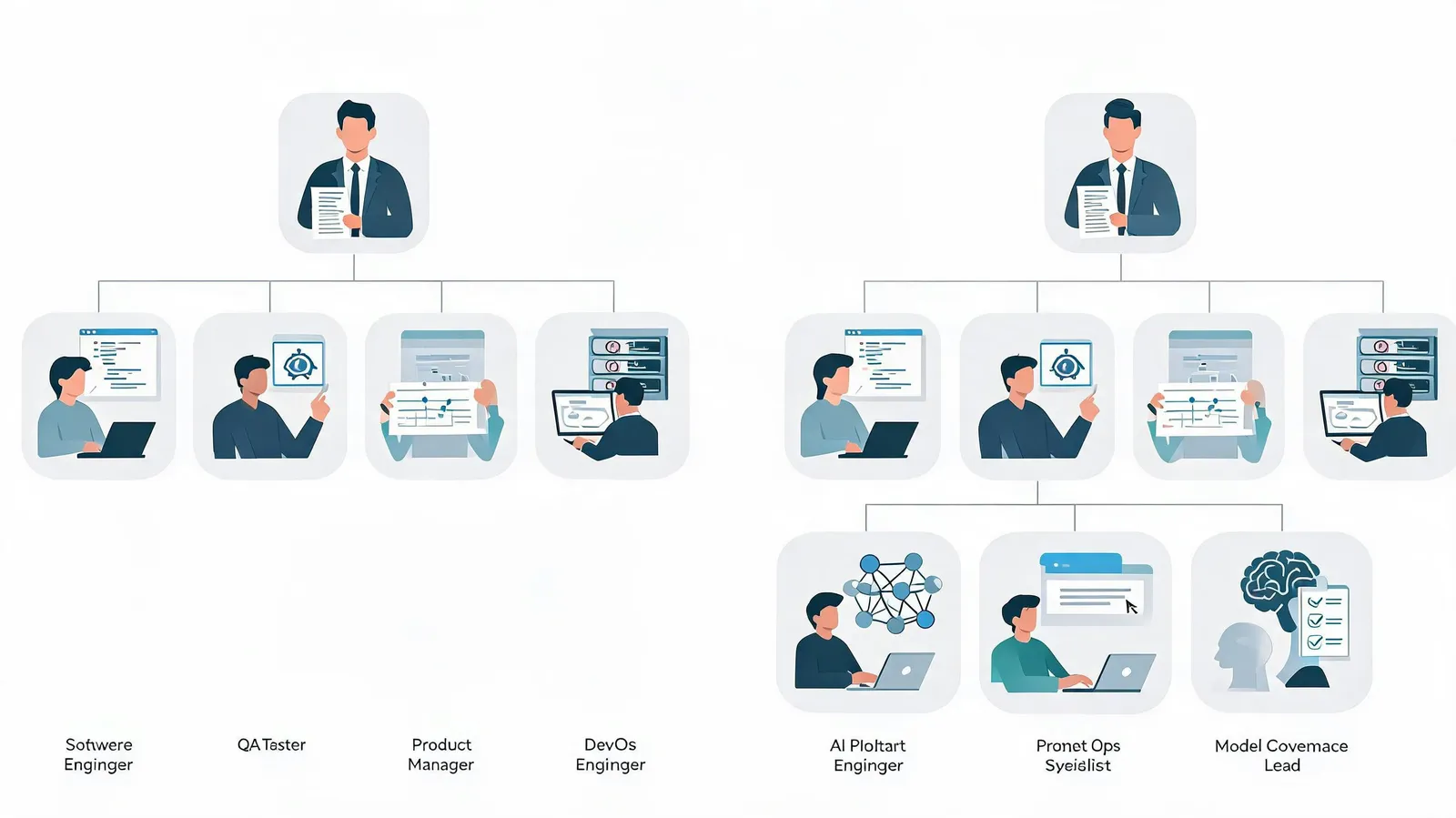
Roles, responsibilities, and team topologies are being reshaped by AI development workflows. Developers are moving from writing code to reviewing and orchestrating it, with growing emphasis on prompt engineering, code review, and system design. New functions are appearing: AI platform teams run infrastructure, prompt operations specialists tune model interactions, and model governance leads handle security and compliance. These roles call for cross-disciplinary skills and clear ownership.
Collaboration patterns and spans of control are changing as well. Code ownership is spread more widely, and review loads shift as AI produces more code. Mentoring and onboarding now incorporate proficiency with AI tools, while knowledge sharing centers on best practices for AI-assisted development. To prevent bottlenecks and maintain accountability, organizations need to redesign team structures.
3. Whether to Build or Buy AI Development Platforms
Strategic trade-offs shape the choice between building an internal AI development platform and purchasing a vendor solution. Building is justified when differentiation, control, and data sensitivity are the top priorities. Proprietary data and workflows can make an internal platform worthwhile, but long-term cost and capability concerns require dedicated platform teams. Buying shortens time-to-value, lowers the maintenance burden, and takes advantage of a maturing ecosystem. As vendor offerings for code generation, testing, and CI/CD integration mature, total cost of ownership comparisons over three to five years often favor buying for non-core functions.
Hybrid models combine vendor tools with internal orchestration. Patterns for integrating third-party AI tools into internal developer portals are taking shape, with decision criteria tied to team size, regulatory context, and roadmap velocity. A hybrid approach balances speed of innovation against control, letting enterprises adopt best-of-breed tools while keeping strategic flexibility.
4. Lock-In Risk and Interoperability in AI Development Toolchains
Proprietary models, APIs, and data formats are the root of vendor lock-in. Examples include AI coding assistants with unique model endpoints and model hosting platforms that use proprietary formats. Switching costs, both contractual and technical, can be considerable. Interoperability strategies reduce these risks through standards, abstraction layers, and open protocols. Open standards such as OpenTelemetry and model context protocols make portability possible. Internal abstraction layers loosen coupling to specific vendors, so components can be replaced.
Balancing innovation velocity with long-term flexibility calls for a portfolio approach to AI tooling vendors. Exit criteria and migration planning for critical AI development tools ensure that organizations can adapt as the market changes. Prioritizing interoperability lets enterprises avoid lock-in while still drawing on cutting-edge AI capabilities.
Conclusion
AI development workflows carry substantial economic and organizational consequences. Deliberate design across ROI measurement, team structure, build-versus-buy decisions, and interoperability is required for sustainable adoption. As AI development platforms converge and interoperability standards mature, AI-native engineering organizations will take shape. Leaders who approach AI development workflows as an integrated system will be in the strongest position to capture value and maintain competitive advantage.