Why Motion Analysis AI Still Misses Some Bodies
Across the United States, motion analysis driven by artificial intelligence has become part of sports training, healthcare delivery, and rehabilitation. Pose estimation models follow joint positions, quantify gait, and evaluate athletic movement as it happens. For people with darker skin tones, non-normative body types, or adaptive equipment, however, these tools often perform poorly. Limited training data and narrow benchmarking—rather than intentional design choices—are the underlying causes. This article looks at where performance breaks down, how dataset diversity and representative benchmarking fit in, what accessibility means for adaptive athletes, and which auditing approaches shape the future of inclusive motion analysis.
1. Where Performance Breaks Down: Skin Tone, Body Type, and Clothing
1.1 Skin Tone Bias in Pose Estimation
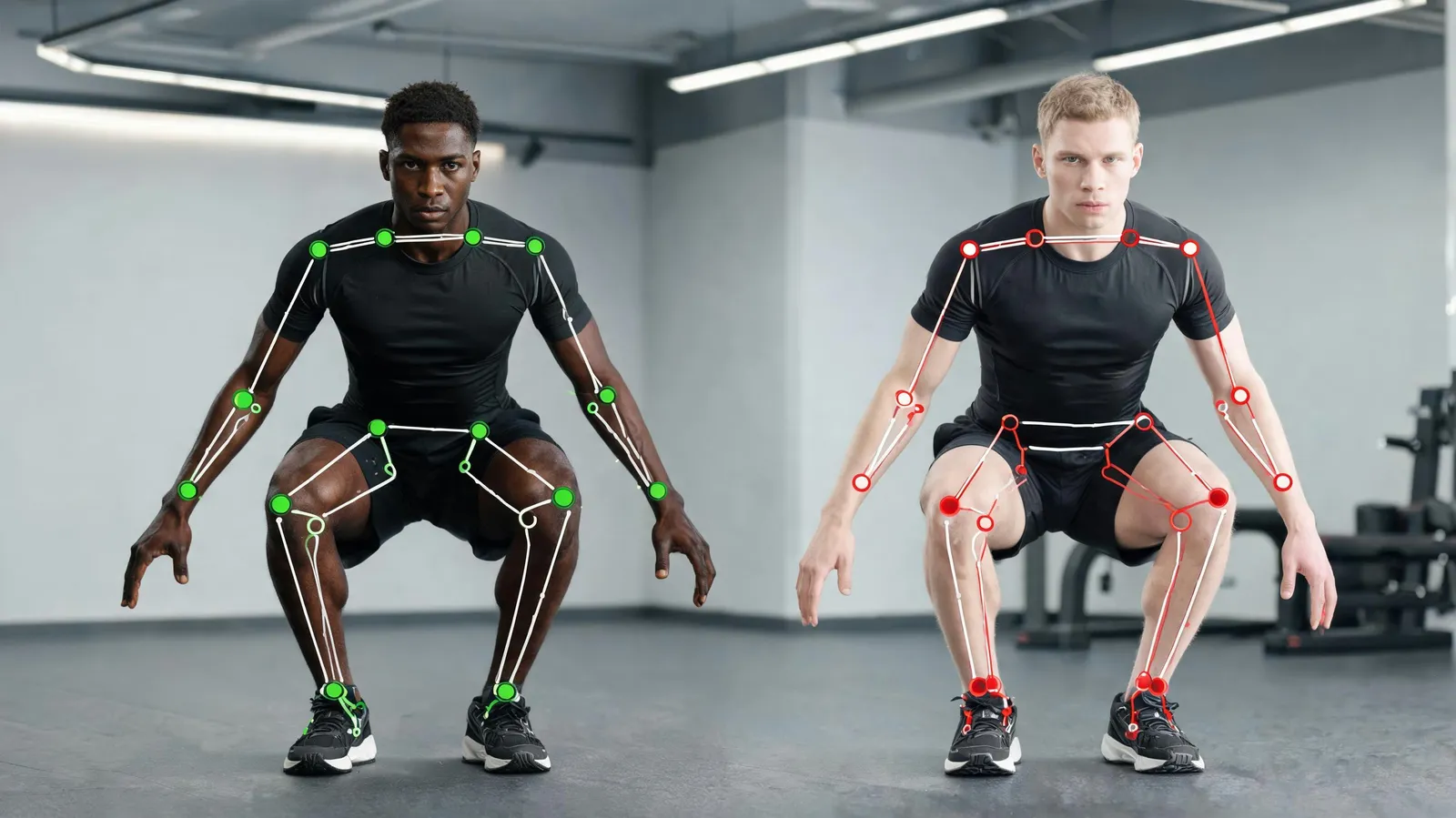
Computer vision has extensively documented skin tone bias. Widely used pose datasets, COCO and MPII among them, are weighted heavily toward lighter-skinned subjects. Models therefore tend to show larger joint localization errors for darker skin, particularly when lighting reduces contrast. For fitness tracking apps, the practical effect is inaccurate repetition counts and form feedback for Black and Brown users; in clinical gait analysis, abnormalities may go undetected.
1.2 Body Type and Clothing Bias
When models are trained on slim bodies in tight clothing, they do not generalize to varied body shapes or loose garments. Benchmark results document marked accuracy declines for plus-size individuals, sumo athletes, and people wearing modest fashion such as hijabs or saris. Basketball players in baggy jerseys and dancers in flowing skirts are affected as well. Such failures shut large populations out of the benefits that motion analysis offers.
2. Dataset Diversity and Representative Benchmarking for Pose Models

2.1 The Root Cause: Skewed Training Data
Existing datasets skew toward light-skinned, able-bodied individuals dressed in Western clothing. Analyses of COCO, MPII, and Human3.6M find that darker skin tones, disabilities, and non-Western clothing are severely underrepresented. This demographic imbalance is a direct cause of the performance disparities described in Section 1.
2.2 Building Inclusive Datasets and Fair Benchmarks
Collection and auditing led by communities are essential. Efforts such as the Inclusive Pose Dataset Project and the Fairness in Biomechanics Benchmark have started to close gaps. Practices that matter include disaggregated evaluation, intersectional analysis, and open annotation pipelines. Fairness metrics for pose estimation—equalized odds and predictive parity among them—help quantify how much progress is being made.
3. Accessibility of AI Movement Tools for Adaptive Athletes and People with Disabilities
3.1 How Standard Models Fail Adaptive Athletes
Adaptive athletes frequently rely on wheelchairs, prosthetics, or other assistive devices, and these can confuse standard pose models. In wheelchair basketball, a model may misclassify the chair as part of the body. In Paralympic training, prosthetic limbs are sometimes ignored or tracked incorrectly. Coaching feedback and injury prevention are both limited by these failures.
3.2 Designing Accessible AI Tools Through Co-Creation
Accessible AI tools call for co-creation with disability communities and model architectures that can adapt. Participatory design case studies indicate that bringing adaptive athletes in from the start improves both accuracy and trust. Open-source adaptive pose libraries, AdaptivePose and OpenWheel among them, provide customizable skeletons for assistive equipment.
4. Auditing Methods for Fairness in Biomechanical AI Systems
4.1 Fairness Auditing Frameworks
Fairness auditing means disaggregated evaluation across demographic groups together with intersectional analysis. Metrics such as equalized odds and predictive parity can be applied to pose estimation. Audits have surfaced hidden biases in commercial fitness and rehabilitation tools. Open-source auditing toolkits for computer vision, including FairVision and AuditAI, make these checks easier to carry out.
4.2 Mitigation Strategies
Reweighting, adversarial debiasing, and post-processing corrections are among the available mitigation strategies. Comparative results indicate that no single technique is perfect, yet combining them narrows error gaps. For inclusive motion analysis, mitigation has to be continuous rather than a one-time fix.
Conclusion: Inclusive Motion Analysis Cannot Wait
Bias in motion analysis AI arises from skin tone, body type, clothing, and the exclusion of people with disabilities. The remedies are clear: diverse datasets, representative benchmarks, accessible design, and rigorous auditing. Equitable healthcare, sports, and rehabilitation depend on fair motion analysis. Integrating fairness by design, supporting community-driven datasets, and building adaptive AI can help ensure that no body is left behind.